An Inland Voyage, by Robert Louis Stevenson
Transcribed from 1904 Chatto & Windus edition by DavidPrice,best animal puppets for 9 year olds under 25 dollars email [email protected] Second proof by MargaretPrice BY ROBERT LOUIS STEVENSON A NEWEDITION WITH AFRONTISPIECE BY WALTER CRANE LONDON ‘Thus sang they in the Englishboat.’ Marvell. To equip so small a book with apreface is, I am half afraid, to sin against proportion. But a preface is more than an author can resist, for it is thereward of his labours. When the foundation stone is laid,the architect appears with his plans, and struts for an hourbefore the public eye. So with the writer in his preface:he may have never a word to say, but he must show himself for amoment in the portico, hat in hand, and with an urbanedemeanour. It is best, in such circumstances, to represent a delicateshade of manner between humility and superiority: as if the bookhad been written by some one else, and you had merely run over itand inserted what was good. But for my part I have not yetlearned the trick to that perfection; I am not yet able todissemble the warmth of my sentiments towards a reader; and if Imeet him on the threshold, it is to invite him in with countrycordiality. To say truth, I had no sooner finished reading this littlebook in proof, than I was seized upon by a distressingapprehension. It occurred to me that I might not only bethe first to read these pages, but the last as well; that I mighthave pioneered this very smiling tract of country all in vain,and find not a soul to follow in my steps. The more Ithought, the more I disliked the notion; until the distaste grewinto a sort of panic terror, and I rushed into this Preface,which is no more than an advertisement for readers. What am I to say for my book? Caleb and Joshua broughtback from Palestine a formidable bunch of grapes; alas! my bookproduces naught so nourishing; and for the matter of that, welive in an age when people prefer a definition to any quantity offruit. I wonder, would a negative be found enticing? for, from thenegative point of view, I flatter myself this volume has acertain stamp. Although it runs to considerably upwards oftwo hundred pages, it contains not a single reference to theimbecility of God’s universe, nor so much as a single hintthat I could have made a better one myself.—I really do notknow where my head can have been. I seem to have forgottenall that makes it glorious to be man.—’Tis anomission that renders the book philosophically unimportant; but Iam in hopes the eccentricity may please in frivolous circles. To the friend who accompanied me I owe many thanks already,indeed I wish I owed him nothing else; but at this moment I feeltowards him an almost exaggerated tenderness. He, at least,will become my reader:—if it were only to follow his owntravels alongside of mine. R.L.S. PAGE Antwerp to Boom 1 On the Willebroek Canal 8 The Royal Sport Nautique 16 At Maubeuge 25 On the Sambre Canalised: toQuartes 33 Pont-sur-Sambre: We arePedlars 42 The TravellingMerchant 51 On the Sambre Canalised: toLandrecies 59 At Landrecies 67 Sambre and Oise Canal: Canalboats 75 The Oise in Flood 83 Origny Sainte-Benoîte A By-day 95 The Company atTable 105 Down the Oise: to Moy 116 La Fère of CursedMemory 124 Down the Oise: Through the GoldenValley 133 Noyon Cathedral 137 Down the Oise: toCompiègne 145 Changed Times 157 Down the Oise: Churchinteriors 167 Précy and theMarionnettes 177 Back to the world 194 My dear Cigarette, It was enough that you should have shared so liberally inthe rains and portages of our voyage; that you should havehad so hard a paddle to recover the derelict‘Arethusa’ on the flooded Oise; andthat you should thenceforth have piloted a mere wreck of mankindto Origny Sainte-Benoîte and a supper so eagerlydesired. It was perhaps more than enough, asyou once somewhat piteously complained, that I should haveset down all the strong language to you, and kept theappropriate reflexions for myself. I could not indecency expose you to share the disgrace of another and morepublic shipwreck. But now that this voyage of oursis going into a cheap edition, that peril, we shallhope, is at an end, and I may put your name on theburgee. But I cannot pause till I have lamented the fate of our twoships. That, sir, was not a fortunateday when we projected the possession of a canal barge; itwas not a fortunate day when we shared our day-dream with themost hopeful of day-dreamers. For a while,indeed, the world looked smilingly. Thebarge was procured and christened, and as the‘Eleven Thousand Virgins of Cologne,’ layfor some months, the admired of all admirers, in apleasant river and under the walls of an ancient town. M. Mattras, the accomplished carpenter of Moret,had made her a centre of emulous labour; and you willnot have forgotten the amount of sweet champagne consumed in theinn at the bridge end, to give zeal to the workmen andspeed to the work. On the financial aspect, Iwould not willingly dwell. The‘ElevenThousand Virgins of Cologne’ rotted in the streamwhere she was beautified. She felt not the impulseof the breeze; she was never harnessed to the patienttrack-horse. And when at length she was sold,by the indignant carpenter of Moret, there were soldalong with her the‘Arethusa’ andthe‘Cigarette,’ she of cedar,she, as we knew so keenly on a portage, ofsolid-hearted English oak. Now these historicvessels fly the tricolor and are known by new and aliennames. R. L. S. We made a great stir in AntwerpDocks. A stevedore and a lot of dock porters took up thetwo canoes, and ran with them for the slip. A crowd ofchildren followed cheering. The Cigarettewent offin a splash and a bubble of small breaking water. Nextmoment the Arethusawas after her. A steamer wascoming down, men on the paddle-box shouted hoarse warnings, thestevedore and his porters were bawling from the quay. Butin a stroke or two the canoes were away out in the middle of theScheldt, and all steamers, and stevedores, and other‘long-shore vanities were left behind. The sun shone brightly; the tide was making—four jollymiles an hour; the wind blew steadily, with occasionalsqualls. For my part, I had never been in a canoe undersail in my life; and my first experiment out in the middle ofthis big river was not made without some trepidation. Whatwould happen when the wind first caught my little canvas? Isuppose it was almost as trying a venture into the regions of theunknown as to publish a first book, or to marry. But mydoubts were not of long duration; and in five minutes you willnot be surprised to learn that I had tied my sheet. I own I was a little struck by this circumstance myself; ofcourse, in company with the rest of my fellow-men, I had alwaystied the sheet in a sailing-boat; but in so little and crank aconcern as a canoe, and with these charging squalls, I was notprepared to find myself follow the same principle; and itinspired me with some contemptuous views of our regard forlife. It is certainly easier to smoke with the sheetfastened; but I had never before weighed a comfortable pipe oftobacco against an obvious risk, and gravely elected for thecomfortable pipe. It is a commonplace, that we cannotanswer for ourselves before we have been tried. But it isnot so common a reflection, and surely more consoling, that weusually find ourselves a great deal braver and better than wethought. I believe this is every one’s experience:but an apprehension that they may belie themselves in the futureprevents mankind from trumpeting this cheerful sentimentabroad. I wish sincerely, for it would have saved me muchtrouble, there had been some one to put me in a good heart aboutlife when I was younger; to tell me how dangers are mostportentous on a distant sight; and how the good in a man’sspirit will not suffer itself to be overlaid, and rarely or neverdeserts him in the hour of need. But we are all fortootling on the sentimental flute in literature; and not a manamong us will go to the head of the march to sound the headydrums. It was agreeable upon the river. A barge or two wentpast laden with hay. Reeds and willows bordered the stream;and cattle and grey venerable horses came and hung their mildheads over the embankment. Here and there was a pleasantvillage among trees, with a noisy shipping-yard; here and there avilla in a lawn. The wind served us well up the Scheldt andthereafter up the Rupel; and we were running pretty free when webegan to sight the brickyards of Boom, lying for a long way onthe right bank of the river. The left bank was still greenand pastoral, with alleys of trees along the embankment, and hereand there a flight of steps to serve a ferry, where perhaps theresat a woman with her elbows on her knees, or an old gentlemanwith a staff and silver spectacles. But Boom and itsbrickyards grew smokier and shabbier with every minute; until agreat church with a clock, and a wooden bridge over the river,indicated the central quarters of the town. Boom is not a nice place, and is only remarkable for onething: that the majority of the inhabitants have a privateopinion that they can speak English, which is not justified byfact. This gave a kind of haziness to ourintercourse. As for the Hôtel de la Navigation, Ithink it is the worst feature of the place. It boasts of asanded parlour, with a bar at one end, looking on the street; andanother sanded parlour, darker and colder, with an emptybird-cage and a tricolour subscription box by way of soleadornment, where we made shift to dine in the company of threeuncommunicative engineer apprentices and a silent bagman. The food, as usual in Belgium, was of a nondescript occasionalcharacter; indeed I have never been able to detect anything inthe nature of a meal among this pleasing people; they seem topeck and trifle with viands all day long in an amateur spirit:tentatively French, truly German, and somehow falling between thetwo. The empty bird-cage, swept and garnished, and with no trace ofthe old piping favourite, save where two wires had been pushedapart to hold its lump of sugar, carried with it a sort ofgraveyard cheer. The engineer apprentices would havenothing to say to us, nor indeed to the bagman; but talked lowand sparingly to one another, or raked us in the gaslight with agleam of spectacles. For though handsome lads, they wereall (in the Scots phrase) barnacled. There was an English maid in the hotel, who had been longenough out of England to pick up all sorts of funny foreignidioms, and all sorts of curious foreign ways, which need nothere be specified. She spoke to us very fluently in herjargon, asked us information as to the manners of the present dayin England, and obligingly corrected us when we attempted toanswer. But as we were dealing with a woman, perhaps ourinformation was not so much thrown away as it appeared. Thesex likes to pick up knowledge and yet preserve itssuperiority. It is good policy, and almost necessary in thecircumstances. If a man finds a woman admire him, were itonly for his acquaintance with geography, he will begin at onceto build upon the admiration. It is only by unintermittentsnubbing that the pretty ones can keep us in our place. Men, as Miss Howe or Miss Harlowe would have said, ‘aresuch encroachers.’ For my part, I am body andsoul with the women; and after a well-married couple, there isnothing so beautiful in the world as the myth of the divinehuntress. It is no use for a man to take to the woods; weknow him; St. Anthony tried the same thing long ago, and had apitiful time of it by all accounts. But there is this aboutsome women, which overtops the best gymnosophist among men, thatthey suffice to themselves, and can walk in a high and cold zonewithout the countenance of any trousered being. I declare,although the reverse of a professed ascetic, I am more obliged towomen for this ideal than I should be to the majority of them, orindeed to any but one, for a spontaneous kiss. There isnothing so encouraging as the spectacle ofself-sufficiency. And when I think of the slim and lovelymaidens, running the woods all night to the note of Diana’shorn; moving among the old oaks, as fancy-free as they; things ofthe forest and the starlight, not touched by the commotion ofman’s hot and turbid life—although there are plentyother ideals that I should prefer—I find my heart beat atthe thought of this one. ’Tis to fail in life, but tofail with what a grace! That is not lost which is notregretted. And where—here slips out themale—where would be much of the glory of inspiring love, ifthere were no contempt to overcome? Next morning, when we set forth onthe Willebroek Canal, the rain began heavy and chill. Thewater of the canal stood at about the drinking temperature oftea; and under this cold aspersion, the surface was covered withsteam. The exhilaration of departure, and the easy motionof the boats under each stroke of the paddles, supported usthrough this misfortune while it lasted; and when the cloudpassed and the sun came out again, our spirits went up above therange of stay-at-home humours. A good breeze rustled andshivered in the rows of trees that bordered the canal. Theleaves flickered in and out of the light in tumultuousmasses. It seemed sailing weather to eye and ear; but downbetween the banks, the wind reached us only in faint anddesultory puffs. There was hardly enough to steer by. Progress was intermittent and unsatisfactory. A jocularperson, of marine antecedents, hailed us from the tow-path with a‘C’est vite, mais c’estlong.’ The canal was busy enough. Every now and then we met orovertook a long string of boats, with great green tillers; highsterns with a window on either side of the rudder, and perhaps ajug or a flower-pot in one of the windows; a dinghy followingbehind; a woman busied about the day’s dinner, and ahandful of children. These barges were all tied one behindthe other with tow ropes, to the number of twenty-five or thirty;and the line was headed and kept in motion by a steamer ofstrange construction. It had neither paddle-wheel norscrew; but by some gear not rightly comprehensible to theunmechanical mind, it fetched up over its bow a small brightchain which lay along the bottom of the canal, and paying it outagain over the stern, dragged itself forward, link by link, withits whole retinue of loaded skows. Until one had found outthe key to the enigma, there was something solemn anduncomfortable in the progress of one of these trains, as it movedgently along the water with nothing to mark its advance but aneddy alongside dying away into the wake. Of all the creatures of commercial enterprise, a canal bargeis by far the most delightful to consider. It may spreadits sails, and then you see it sailing high above the tree-topsand the windmill, sailing on the aqueduct, sailing through thegreen corn-lands: the most picturesque of thingsamphibious. Or the horse plods along at a foot-pace as ifthere were no such thing as business in the world; and the mandreaming at the tiller sees the same spire on the horizon all daylong. It is a mystery how things ever get to theirdestination at this rate; and to see the barges waiting theirturn at a lock, affords a fine lesson of how easily the world maybe taken. There should be many contented spirits on board,for such a life is both to travel and to stay at home. The chimney smokes for dinner as you go along; the banks ofthe canal slowly unroll their scenery to contemplative eyes; thebarge floats by great forests and through great cities with theirpublic buildings and their lamps at night; and for the bargee, inhis floating home, ‘travelling abed,’ it is merely asif he were listening to another man’s story or turning theleaves of a picture-book in which he had no concern. He maytake his afternoon walk in some foreign country on the banks ofthe canal, and then come home to dinner at his own fireside. There is not enough exercise in such a life for any highmeasure of health; but a high measure of health is only necessaryfor unhealthy people. The slug of a fellow, who is neverill nor well, has a quiet time of it in life, and dies all theeasier. I am sure I would rather be a bargee than occupy any positionunder heaven that required attendance at an office. Thereare few callings, I should say, where a man gives up less of hisliberty in return for regular meals. The bargee is onshipboard—he is master in his own ship—he can landwhenever he will—he can never be kept beating off alee-shore a whole frosty night when the sheets are as hard asiron; and so far as I can make out, time stands as nearly stillwith him as is compatible with the return of bed-time or thedinner-hour. It is not easy to see why a bargee should everdie. Half-way between Willebroek and Villevorde, in a beautifulreach of canal like a squire’s avenue, we went ashore tolunch. There were two eggs, a junk of bread, and a bottleof wine on board the Arethusa; and two eggs and an Etnacooking apparatus on board the Cigarette. The masterof the latter boat smashed one of the eggs in the course ofdisembarkation; but observing pleasantly that it might still becooked à la papier, he dropped it into the Etna, inits covering of Flemish newspaper. We landed in a blink offine weather; but we had not been two minutes ashore before thewind freshened into half a gale, and the rain began to patter onour shoulders. We sat as close about the Etna as wecould. The spirits burned with great ostentation; the grasscaught flame every minute or two, and had to be trodden out; andbefore long, there were several burnt fingers of the party. But the solid quantity of cookery accomplished was out ofproportion with so much display; and when we desisted, after twoapplications of the fire, the sound egg was little more thanloo-warm; and as for à la papier, it was a cold andsordid fricasséeof printer’s ink and brokenegg-shell. We made shift to roast the other two, by puttingthem close to the burning spirits; and that with bettersuccess. And then we uncorked the bottle of wine, and satdown in a ditch with our canoe aprons over our knees. Itrained smartly. Discomfort, when it is honestlyuncomfortable and makes no nauseous pretensions to the contrary,is a vastly humorous business; and people well steeped andstupefied in the open air are in a good vein for laughter. From this point of view, even egg à la papieroffered by way of food may pass muster as a sort of accessory tothe fun. But this manner of jest, although it may be takenin good part, does not invite repetition; and from that timeforward, the Etna voyaged like a gentleman in the locker of theCigarette. It is almost unnecessary to mention that when lunch was overand we got aboard again and made sail, the wind promptly diedaway. The rest of the journey to Villevorde, we stillspread our canvas to the unfavouring air; and with now and then apuff, and now and then a spell of paddling, drifted along fromlock to lock, between the orderly trees. It was a fine, green, fat landscape; or rather a mere greenwater-lane, going on from village to village. Things had asettled look, as in places long lived in. Crop-headedchildren spat upon us from the bridges as we went below, with atrue conservative feeling. But even more conservative werethe fishermen, intent upon their floats, who let us go by withoutone glance. They perched upon sterlings and buttresses andalong the slope of the embankment, gently occupied. Theywere indifferent, like pieces of dead nature. They did notmove any more than if they had been fishing in an old Dutchprint. The leaves fluttered, the water lapped, but theycontinued in one stay like so many churches established bylaw. You might have trepanned every one of their innocentheads, and found no more than so much coiled fishing-line belowtheir skulls. I do not care for your stalwart fellows inindia-rubber stockings breasting up mountain torrents with asalmon rod; but I do dearly love the class of man who plies hisunfruitful art, for ever and a day, by still and depopulatedwaters. At the last lock, just beyond Villevorde, there was alock-mistress who spoke French comprehensibly, and told us wewere still a couple of leagues from Brussels. At the sameplace, the rain began again. It fell in straight, parallellines; and the surface of the canal was thrown up into aninfinity of little crystal fountains. There were no beds tobe had in the neighbourhood. Nothing for it but to lay thesails aside and address ourselves to steady paddling in therain. Beautiful country houses, with clocks and long lines ofshuttered windows, and fine old trees standing in groves andavenues, gave a rich and sombre aspect in the rain and thedeepening dusk to the shores of the canal. I seem to haveseen something of the same effect in engravings: opulentlandscapes, deserted and overhung with the passage ofstorm. And throughout we had the escort of a hooded cart,which trotted shabbily along the tow-path, and kept at an almostuniform distance in our wake. The rain took off nearLaeken. But the sun was already down; the air was chill;and we had scarcely a dry stitch between the pair of us. Nay, now we found ourselves near the end of the AlléeVerte, and on the very threshold of Brussels, we were confrontedby a serious difficulty. The shores were closely lined bycanal boats waiting their turn at the lock. Nowhere wasthere any convenient landing-place; nowhere so much as astable-yard to leave the canoes in for the night. Wescrambled ashore and entered an estaminetwhere some sorryfellows were drinking with the landlord. The landlord waspretty round with us; he knew of no coach-house or stable-yard,nothing of the sort; and seeing we had come with no mind todrink, he did not conceal his impatience to be rid of us. One of the sorry fellows came to the rescue. Somewhere inthe corner of the basin there was a slip, he informed us, andsomething else besides, not very clearly defined by him, buthopefully construed by his hearers. Sure enough there was the slip in the corner of the basin; andat the top of it two nice-looking lads in boating clothes. The Arethusaaddressed himself to these. One of themsaid there would be no difficulty about a night’s lodgingfor our boats; and the other, taking a cigarette from his lips,inquired if they were made by Searle and Son. The name wasquite an introduction. Half-a-dozen other young men cameout of a boat-house bearing the superscription Royal Sport Nautique, and joined in thetalk. They were all very polite, voluble, and enthusiastic;and their discourse was interlarded with English boating terms,and the names of English boat-builders and English clubs. Ido not know, to my shame, any spot in my native land where Ishould have been so warmly received by the same number ofpeople. We were English boating-men, and the Belgianboating-men fell upon our necks. I wonder if FrenchHuguenots were as cordially greeted by English Protestants whenthey came across the Channel out of great tribulation. Butafter all, what religion knits people so closely as a commonsport? The canoes were carried into the boat-house; they were washeddown for us by the Club servants, the sails were hung out to dry,and everything made as snug and tidy as a picture. And inthe meanwhile we were led upstairs by our new-found brethren, forso more than one of them stated the relationship, and made freeof their lavatory. This one lent us soap, that one a towel,a third and fourth helped us to undo our bags. And all thetime such questions, such assurances of respect andsympathy! I declare I never knew what glory was before. ‘Yes, yes, the Royal Sport Nautiqueis the oldestclub in Belgium.’ ‘We number two hundred.’ ‘We’—this is not a substantive speech, butan abstract of many speeches, the impression left upon my mindafter a great deal of talk; and very youthful, pleasant, natural,and patriotic it seems to me to be—‘We have gainedall races, except those where we were cheated by theFrench.’ ‘You must leave all your wet things to bedried.’ ‘O! entre frères! In any boat-housein England we should find the same.’ (I cordiallyhope they might.) ‘En Angleterre, vous employez dessliding-seats, n’est-ce pas?’ ‘We are all employed in commerce during the day; but inthe evening, voyez-vous, nous sommessérieux.’ These were the words. They were all employed over thefrivolous mercantile concerns of Belgium during the day; but inthe evening they found some hours for the serious concerns oflife. I may have a wrong idea of wisdom, but I think thatwas a very wise remark. People connected with literatureand philosophy are busy all their days in getting rid ofsecond-hand notions and false standards. It is theirprofession, in the sweat of their brows, by dogged thinking, torecover their old fresh view of life, and distinguish what theyreally and originally like, from what they have only learned totolerate perforce. And these Royal Nautical Sportsmen hadthe distinction still quite legible in their hearts. Theyhad still those clean perceptions of what is nice and nasty, whatis interesting and what is dull, which envious old gentlemenrefer to as illusions. The nightmare illusion of middleage, the bear’s hug of custom gradually squeezing the lifeout of a man’s soul, had not yet begun for thesehappy-starred young Belgians. They still knew that theinterest they took in their business was a trifling affaircompared to their spontaneous, long-suffering affection fornautical sports. To know what you prefer, instead of humblysaying Amen to what the world tells you you ought to prefer, isto have kept your soul alive. Such a man may be generous;he may be honest in something more than the commercial sense; hemay love his friends with an elective, personal sympathy, and notaccept them as an adjunct of the station to which he has beencalled. He may be a man, in short, acting on his owninstincts, keeping in his own shape that God made him in; and nota mere crank in the social engine-house, welded on principlesthat he does not understand, and for purposes that he does notcare for. For will any one dare to tell me that business is moreentertaining than fooling among boats? He must have neverseen a boat, or never seen an office, who says so. And forcertain the one is a great deal better for the health. There should be nothing so much a man’s business as hisamusements. Nothing but money-grubbing can be put forwardto the contrary; no one but Mammon, the least erected spirit that fell durst risk a word in answer. It is but a lying cant thatwould represent the merchant and the banker as peopledisinterestedly toiling for mankind, and then most useful whenthey are most absorbed in their transactions; for the man is moreimportant than his services. And when my Royal NauticalSportsman shall have so far fallen from his hopeful youth that hecannot pluck up an enthusiasm over anything but his ledger, Iventure to doubt whether he will be near so nice a fellow, andwhether he would welcome, with so good a grace, a couple ofdrenched Englishmen paddling into Brussels in the dusk. When we had changed our wet clothes and drunk a glass of paleale to the Club’s prosperity, one of their number escortedus to an hotel. He would not join us at our dinner, but hehad no objection to a glass of wine. Enthusiasm is verywearing; and I begin to understand why prophets were unpopular inJudæa, where they were best known. For three strickenhours did this excellent young man sit beside us to dilate onboats and boat-races; and before he left, he was kind enough toorder our bedroom candles. We endeavoured now and again to change the subject; but thediversion did not last a moment: the Royal Nautical Sportsmanbridled, shied, answered the question, and then breasted oncemore into the swelling tide of his subject. I call it hissubject; but I think it was he who was subjected. TheArethusa, who holds all racing as a creature of the devil,found himself in a pitiful dilemma. He durst not own hisignorance for the honour of Old England, and spoke away aboutEnglish clubs and English oarsmen whose fame had never beforecome to his ears. Several times, and, once above all, onthe question of sliding-seats, he was within an ace ofexposure. As for the Cigarette, who has rowed racesin the heat of his blood, but now disowns these slips of hiswanton youth, his case was still more desperate; for the RoyalNautical proposed that he should take an oar in one of theireights on the morrow, to compare the English with the Belgianstroke. I could see my friend perspiring in his chairwhenever that particular topic came up. And there was yetanother proposal which had the same effect on both of us. It appeared that the champion canoeist of Europe (as well as mostother champions) was a Royal Nautical Sportsman. And if wewould only wait until the Sunday, this infernal paddler would beso condescending as to accompany us on our next stage. Neither of us had the least desire to drive the coursers of thesun against Apollo. When the young man was gone, we countermanded our candles, andordered some brandy and water. The great billows had goneover our head. The Royal Nautical Sportsmen were as niceyoung fellows as a man would wish to see, but they were a trifletoo young and a thought too nautical for us. We began tosee that we were old and cynical; we liked ease and the agreeablerambling of the human mind about this and the other subject; wedid not want to disgrace our native land by messing an eight, ortoiling pitifully in the wake of the champion canoeist. Inshort, we had recourse to flight. It seemed ungrateful, butwe tried to make that good on a card loaded with sincerecompliments. And indeed it was no time for scruples; weseemed to feel the hot breath of the champion on our necks. Partly from the terror we had ofour good friends the Royal Nauticals, partly from the fact thatthere were no fewer than fifty-five locks between Brussels andCharleroi, we concluded that we should travel by train across thefrontier, boats and all. Fifty-five locks in a day’sjourney was pretty well tantamount to trudging the whole distanceon foot, with the canoes upon our shoulders, an object ofastonishment to the trees on the canal side, and of honestderision to all right-thinking children. To pass the frontier, even in a train, is a difficult matterfor the Arethusa. He is somehow or other a markedman for the official eye. Wherever he journeys, there arethe officers gathered together. Treaties are solemnlysigned, foreign ministers, ambassadors, and consuls sit thronedin state from China to Peru, and the Union Jack flutters on allthe winds of heaven. Under these safeguards, portlyclergymen, school-mistresses, gentlemen in grey tweed suits, andall the ruck and rabble of British touristry pour unhindered,Murrayin hand, over the railways of the Continent, andyet the slim person of the Arethusais taken in themeshes, while these great fish go on their way rejoicing. If he travels without a passport, he is cast, without any figureabout the matter, into noisome dungeons: if his papers are inorder, he is suffered to go his way indeed, but not until he hasbeen humiliated by a general incredulity. He is a bornBritish subject, yet he has never succeeded in persuading asingle official of his nationality. He flatters himself heis indifferent honest; yet he is rarely taken for anything betterthan a spy, and there is no absurd and disreputable means oflivelihood but has been attributed to him in some heat ofofficial or popular distrust. . . . For the life of me I cannot understand it. I too havebeen knolled to church, and sat at good men’s feasts; but Ibear no mark of it. I am as strange as a Jack Indian totheir official spectacles. I might come from any part ofthe globe, it seems, except from where I do. My ancestorshave laboured in vain, and the glorious Constitution cannotprotect me in my walks abroad. It is a great thing, believeme, to present a good normal type of the nation you belongto. Nobody else was asked for his papers on the way to Maubeuge;but I was; and although I clung to my rights, I had to choose atlast between accepting the humiliation and being left behind bythe train. I was sorry to give way; but I wanted to get toMaubeuge. Maubeuge is a fortified town, with a very good inn, theGrand Cerf. It seemed to be inhabited principally bysoldiers and bagmen; at least, these were all that we saw, exceptthe hotel servants. We had to stay there some time, for thecanoes were in no hurry to follow us, and at last stuckhopelessly in the custom-house until we went back to liberatethem. There was nothing to do, nothing to see. We hadgood meals, which was a great matter; but that was all. The Cigarettewas nearly taken up upon a charge ofdrawing the fortifications: a feat of which he was hopelesslyincapable. And besides, as I suppose each belligerentnation has a plan of the other’s fortified places already,these precautions are of the nature of shutting the stable doorafter the steed is away. But I have no doubt they help tokeep up a good spirit at home. It is a great thing if youcan persuade people that they are somehow or other partakers in amystery. It makes them feel bigger. Even theFreemasons, who have been shown up to satiety, preserve a kind ofpride; and not a grocer among them, however honest, harmless, andempty-headed he may feel himself to be at bottom, but comes homefrom one of their coenaculawith a portentous significancefor himself. It is an odd thing, how happily two people, if there are two,can live in a place where they have no acquaintance. Ithink the spectacle of a whole life in which you have no partparalyses personal desire. You are content to become a merespectator. The baker stands in his door; the colonel withhis three medals goes by to the caféat night; thetroops drum and trumpet and man the ramparts, as bold as so manylions. It would task language to say how placidly youbehold all this. In a place where you have taken some root,you are provoked out of your indifference; you have a hand in thegame; your friends are fighting with the army. But in astrange town, not small enough to grow too soon familiar, nor solarge as to have laid itself out for travellers, you stand so farapart from the business, that you positively forget it would bepossible to go nearer; you have so little human interest aroundyou, that you do not remember yourself to be a man. Perhaps, in a very short time, you would be one no longer. Gymnosophists go into a wood, with all nature seething aroundthem, with romance on every side; it would be much more to thepurpose if they took up their abode in a dull country town, wherethey should see just so much of humanity as to keep them fromdesiring more, and only the stale externals of man’slife. These externals are as dead to us as so manyformalities, and speak a dead language in our eyes andears. They have no more meaning than an oath or asalutation. We are so much accustomed to see marriedcouples going to church of a Sunday that we have clean forgottenwhat they represent; and novelists are driven to rehabilitateadultery, no less, when they wish to show us what a beautifulthing it is for a man and a woman to live for each other. One person in Maubeuge, however, showed me something more thanhis outside. That was the driver of the hotel omnibus: amean enough looking little man, as well as I can remember; butwith a spark of something human in his soul. He had heardof our little journey, and came to me at once in envioussympathy. How he longed to travel! he told me. How helonged to be somewhere else, and see the round world before hewent into the grave! ‘Here I am,’ saidhe. ‘I drive to the station. Well. Andthen I drive back again to the hotel. And so on every dayand all the week round. My God, is that life?’ I could not say I thought it was—for him. He pressedme to tell him where I had been, and where I hoped to go; and ashe listened, I declare the fellow sighed. Might not thishave been a brave African traveller, or gone to the Indies afterDrake? But it is an evil age for the gypsily inclined amongmen. He who can sit squarest on a three-legged stool, he itis who has the wealth and glory. I wonder if my friend is still driving the omnibus for theGrand Cerf? Not very likely, I believe; for I think he wason the eve of mutiny when we passed through, and perhaps ourpassage determined him for good. Better a thousand timesthat he should be a tramp, and mend pots and pans by the wayside,and sleep under trees, and see the dawn and the sunset every dayabove a new horizon. I think I hear you say that it is arespectable position to drive an omnibus? Very well. What right has he who likes it not, to keep those who would likeit dearly out of this respectable position? Suppose a dishwere not to my taste, and you told me that it was a favouriteamongst the rest of the company, what should I conclude fromthat? Not to finish the dish against my stomach, Isuppose. Respectability is a very good thing in its way, but it doesnot rise superior to all considerations. I would not for amoment venture to hint that it was a matter of taste; but I thinkI will go as far as this: that if a position is admittedlyunkind, uncomfortable, unnecessary, and superfluously useless,although it were as respectable as the Church of England, thesooner a man is out of it, the better for himself, and allconcerned. About three in the afternoon thewhole establishment of the Grand Cerfaccompanied us tothe water’s edge. The man of the omnibus was therewith haggard eyes. Poor cage-bird! Do I not rememberthe time when I myself haunted the station, to watch train aftertrain carry its complement of freemen into the night, and readthe names of distant places on the time-bills with indescribablelongings? We were not clear of the fortifications before the rainbegan. The wind was contrary, and blew in furious gusts;nor were the aspects of nature any more clement than the doingsof the sky. For we passed through a stretch of blightedcountry, sparsely covered with brush, but handsomely enoughdiversified with factory chimneys. We landed in a soiledmeadow among some pollards, and there smoked a pipe in a flaw offair weather. But the wind blew so hard, we could getlittle else to smoke. There were no natural objects in theneighbourhood, but some sordid workshops. A group ofchildren headed by a tall girl stood and watched us from a littledistance all the time we stayed. I heartily wonder whatthey thought of us. At Hautmont, the lock was almost impassable; the landing-placebeing steep and high, and the launch at a long distance. Near a dozen grimy workmen lent us a hand. They refused anyreward; and, what is much better, refused it handsomely, withoutconveying any sense of insult. ‘It is a way we havein our countryside,’ said they. And a very becomingway it is. In Scotland, where also you will get servicesfor nothing, the good people reject your money as if you had beentrying to corrupt a voter. When people take the trouble todo dignified acts, it is worth while to take a little more, andallow the dignity to be common to all concerned. But in ourbrave Saxon countries, where we plod threescore years and ten inthe mud, and the wind keeps singing in our ears from birth toburial, we do our good and bad with a high hand and almostoffensively; and make even our alms a witness-bearing and an actof war against the wrong. After Hautmont, the sun came forth again and the wind wentdown; and a little paddling took us beyond the ironworks andthrough a delectable land. The river wound among low hills,so that sometimes the sun was at our backs, and sometimes itstood right ahead, and the river before us was one sheet ofintolerable glory. On either hand, meadows and orchardsbordered, with a margin of sedge and water flowers, upon theriver. The hedges were of great height, woven about thetrunks of hedgerow elms; and the fields, as they were often verysmall, looked like a series of bowers along the stream. There was never any prospect; sometimes a hill-top with its treeswould look over the nearest hedgerow, just to make a middledistance for the sky; but that was all. The heaven was bareof clouds. The atmosphere, after the rain, was ofenchanting purity. The river doubled among the hillocks, ashining strip of mirror glass; and the dip of the paddles set theflowers shaking along the brink. In the meadows wandered black and white cattle fantasticallymarked. One beast, with a white head and the rest of thebody glossy black, came to the edge to drink, and stood gravelytwitching his ears at me as I went by, like some sort ofpreposterous clergyman in a play. A moment after I heard aloud plunge, and, turning my head, saw the clergyman strugglingto shore. The bank had given way under his feet. Besides the cattle, we saw no living things except a few birdsand a great many fishermen. These sat along the edges ofthe meadows, sometimes with one rod, sometimes with as many ashalf a score. They seemed stupefied with contentment; andwhen we induced them to exchange a few words with us about theweather, their voices sounded quiet and far away. There wasa strange diversity of opinion among them as to the kind of fishfor which they set their lures; although they were all agreed inthis, that the river was abundantly supplied. Where it wasplain that no two of them had ever caught the same kind of fish,we could not help suspecting that perhaps not any one of them hadever caught a fish at all. I hope, since the afternoon wasso lovely, that they were one and all rewarded; and that a silverbooty went home in every basket for the pot. Some of myfriends would cry shame on me for this; but I prefer a man, werehe only an angler, to the bravest pair of gills in allGod’s waters. I do not affect fishes unless whencooked in sauce; whereas an angler is an important piece of riverscenery, and hence deserves some recognition amongcanoeists. He can always tell you where you are after amild fashion; and his quiet presence serves to accentuate thesolitude and stillness, and remind you of the glittering citizensbelow your boat. The Sambre turned so industriously to and fro among his littlehills, that it was past six before we drew near the lock atQuartes. There were some children on the tow-path, withwhom the Cigarettefell into a chaffing talk as they ranalong beside us. It was in vain that I warned him. Invain I told him, in English, that boys were the most dangerouscreatures; and if once you began with them, it was safe to end ina shower of stones. For my own part, whenever anything wasaddressed to me, I smiled gently and shook my head as though Iwere an inoffensive person inadequately acquainted withFrench. For indeed I have had such experience at home, thatI would sooner meet many wild animals than a troop of healthyurchins. But I was doing injustice to these peaceable youngHainaulters. When the Cigarettewent off to makeinquiries, I got out upon the bank to smoke a pipe andsuperintend the boats, and became at once the centre of muchamiable curiosity. The children had been joined by thistime by a young woman and a mild lad who had lost an arm; andthis gave me more security. When I let slip my first wordor so in French, a little girl nodded her head with a comicalgrown-up air. ‘Ah, you see,’ she said,‘he understands well enough now; he was just makingbelieve.’ And the little group laughed together verygood-naturedly. They were much impressed when they heard we came from England;and the little girl proffered the information that England was anisland ‘and a far way from here—bien loind’ici.’ ‘Ay, you may say that, a far way from here,’ saidthe lad with one arm. I was as nearly home-sick as ever I was in my life; theyseemed to make it such an incalculable distance to the placewhere I first saw the day. They admired the canoes verymuch. And I observed one piece of delicacy in thesechildren, which is worthy of record. They had beendeafening us for the last hundred yards with petitions for asail; ay, and they deafened us to the same tune next morning whenwe came to start; but then, when the canoes were lying empty,there was no word of any such petition. Delicacy? orperhaps a bit of fear for the water in so crank a vessel? Ihate cynicism a great deal worse than I do the devil; unlessperhaps the two were the same thing? And yet ’tis agood tonic; the cold tub and bath-towel of the sentiments; andpositively necessary to life in cases of advancedsensibility. From the boats they turned to my costume. They could notmake enough of my red sash; and my knife filled them withawe. ‘They make them like that in England,’ said theboy with one arm. I was glad he did not know how badly wemake them in England now-a-days. ‘They are for peoplewho go away to sea,’ he added, ‘and to defendone’s life against great fish.’ I felt I was becoming a more and more romantic figure to thelittle group at every word. And so I suppose I was. Even my pipe, although it was an ordinary French clay pretty well‘trousered,’ as they call it, would have a rarity intheir eyes, as a thing coming from so far away. And if myfeathers were not very fine in themselves, they were all fromover seas. One thing in my outfit, however, tickled themout of all politeness; and that was the bemired condition of mycanvas shoes. I suppose they were sure the mud at any ratewas a home product. The little girl (who was the genius ofthe party) displayed her own sabots in competition; and I wishyou could have seen how gracefully and merrily she did it. The young woman’s milk-can, a great amphora of hammeredbrass, stood some way off upon the sward. I was glad of anopportunity to divert public attention from myself, and returnsome of the compliments I had received. So I admired itcordially both for form and colour, telling them, and very truly,that it was as beautiful as gold. They were notsurprised. The things were plainly the boast of thecountryside. And the children expatiated on the costlinessof these amphoræ, which sell sometimes as high as thirtyfrancs apiece; told me how they were carried on donkeys, one oneither side of the saddle, a brave caparison in themselves; andhow they were to be seen all over the district, and at the largerfarms in great number and of great size. The Cigarettereturned withgood news. There were beds to be had some tenminutes’ walk from where we were, at a place calledPont. We stowed the canoes in a granary, and asked amongthe children for a guide. The circle at once widened roundus, and our offers of reward were received in dispiritingsilence. We were plainly a pair of Bluebeards to thechildren; they might speak to us in public places, and where theyhad the advantage of numbers; but it was another thing to ventureoff alone with two uncouth and legendary characters, who haddropped from the clouds upon their hamlet this quiet afternoon,sashed and be-knived, and with a flavour of great voyages. The owner of the granary came to our assistance, singled out onelittle fellow and threatened him with corporalities; or I suspectwe should have had to find the way for ourselves. As itwas, he was more frightened at the granary man than thestrangers, having perhaps had some experience of theformer. But I fancy his little heart must have been goingat a fine rate; for he kept trotting at a respectful distance infront, and looking back at us with scared eyes. Nototherwise may the children of the young world have guided Jove orone of his Olympian compeers on an adventure. A miry lane led us up from Quartes with its church andbickering windmill. The hinds were trudging homewards fromthe fields. A brisk little woman passed us by. Shewas seated across a donkey between a pair of glitteringmilk-cans; and, as she went, she kicked jauntily with her heelsupon the donkey’s side, and scattered shrill remarks amongthe wayfarers. It was notable that none of the tired mentook the trouble to reply. Our conductor soon led us out ofthe lane and across country. The sun had gone down, but thewest in front of us was one lake of level gold. The pathwandered a while in the open, and then passed under a trellislike a bower indefinitely prolonged. On either hand wereshadowy orchards; cottages lay low among the leaves, and senttheir smoke to heaven; every here and there, in an opening,appeared the great gold face of the west. I never saw the Cigarettein such an idyllic frame ofmind. He waxed positively lyrical in praise of countryscenes. I was little less exhilarated myself; the mild airof the evening, the shadows, the rich lights and the silence,made a symphonious accompaniment about our walk; and we bothdetermined to avoid towns for the future and sleep inhamlets. At last the path went between two houses, and turned the partyout into a wide muddy high-road, bordered, as far as the eyecould reach on either hand, by an unsightly village. Thehouses stood well back, leaving a ribbon of waste land on eitherside of the road, where there were stacks of firewood, carts,barrows, rubbish-heaps, and a little doubtful grass. Awayon the left, a gaunt tower stood in the middle of thestreet. What it had been in past ages, I know not: probablya hold in time of war; but now-a-days it bore an illegibledial-plate in its upper parts, and near the bottom an ironletter-box. The inn to which we had been recommended at Quartes was full,or else the landlady did not like our looks. I ought tosay, that with our long, damp india-rubber bags, we presentedrather a doubtful type of civilisation: like rag-and-bone men,the Cigaretteimagined. ‘These gentlemen arepedlars?—Ces messieurs sont desmarchands?’—asked the landlady. And then,without waiting for an answer, which I suppose she thoughtsuperfluous in so plain a case, recommended us to a butcher wholived hard by the tower, and took in travellers to lodge. Thither went we. But the butcher was flitting, and allhis beds were taken down. Or else he didn’t like ourlook. As a parting shot, we had ‘These gentlemen arepedlars?’ It began to grow dark in earnest. We could no longerdistinguish the faces of the people who passed us by with aninarticulate good-evening. And the householders of Pontseemed very economical with their oil; for we saw not a singlewindow lighted in all that long village. I believe it isthe longest village in the world; but I daresay in ourpredicament every pace counted three times over. We weremuch cast down when we came to the last auberge; and looking inat the dark door, asked timidly if we could sleep there for thenight. A female voice assented in no very friendlytones. We clapped the bags down and found our way tochairs. The place was in total darkness, save a red glow in the chinksand ventilators of the stove. But now the landlady lit alamp to see her new guests; I suppose the darkness was what savedus another expulsion; for I cannot say she looked gratified atour appearance. We were in a large bare apartment, adornedwith two allegorical prints of Music and Painting, and a copy ofthe law against public drunkenness. On one side, there wasa bit of a bar, with some half-a-dozen bottles. Twolabourers sat waiting supper, in attitudes of extreme weariness;a plain-looking lass bustled about with a sleepy child of two;and the landlady began to derange the pots upon the stove, andset some beefsteak to grill. ‘These gentlemen are pedlars?’ she askedsharply. And that was all the conversationforthcoming. We began to think we might be pedlars afterall. I never knew a population with so narrow a range ofconjecture as the innkeepers of Pont-sur-Sambre. Butmanners and bearing have not a wider currency thanbank-notes. You have only to get far enough out of yourbeat, and all your accomplished airs will go for nothing. These Hainaulters could see no difference between us and theaverage pedlar. Indeed we had some grounds for reflectionwhile the steak was getting ready, to see how perfectly theyaccepted us at their own valuation, and how our best politenessand best efforts at entertainment seemed to fit quite suitablywith the character of packmen. At least it seemed a goodaccount of the profession in France, that even before such judgeswe could not beat them at our own weapons. At last we were called to table. The two hinds (and oneof them looked sadly worn and white in the face, as though sickwith over-work and under-feeding) supped off a single plate ofsome sort of bread-berry, some potatoes in their jackets, a smallcup of coffee sweetened with sugar-candy, and one tumbler ofswipes. The landlady, her son, and the lass aforesaid, tookthe same. Our meal was quite a banquet by comparison. We had some beefsteak, not so tender as it might have been, someof the potatoes, some cheese, an extra glass of the swipes, andwhite sugar in our coffee. You see what it is to be a gentleman—I beg your pardon,what it is to be a pedlar. It had not before occurred to methat a pedlar was a great man in a labourer’s ale-house;but now that I had to enact the part for an evening, I found thatso it was. He has in his hedge quarters somewhat the samepre-eminency as the man who takes a private parlour in anhotel. The more you look into it, the more infinite are theclass distinctions among men; and possibly, by a happydispensation, there is no one at all at the bottom of the scale;no one but can find some superiority over somebody else, to keepup his pride withal. We were displeased enough with our fare. Particularlythe Cigarette, for I tried to make believe that I wasamused with the adventure, tough beefsteak and all. According to the Lucretian maxim, our steak should have beenflavoured by the look of the other people’sbread-berry. But we did not find it so in practice. You may have a head-knowledge that other people live more poorlythan yourself, but it is not agreeable—I was going to say,it is against the etiquette of the universe—to sit at thesame table and pick your own superior diet from among theircrusts. I had not seen such a thing done since the greedyboy at school with his birthday cake. It was odious enoughto witness, I could remember; and I had never thought to play thepart myself. But there again you see what it is to be apedlar. There is no doubt that the poorer classes in our country aremuch more charitably disposed than their superiors inwealth. And I fancy it must arise a great deal from thecomparative indistinction of the easy and the not so easy inthese ranks. A workman or a pedlar cannot shutter himselfoff from his less comfortable neighbours. If he treatshimself to a luxury, he must do it in the face of a dozen whocannot. And what should more directly lead to charitablethoughts? . . . Thus the poor man, camping out in life, sees itas it is, and knows that every mouthful he puts in his belly hasbeen wrenched out of the fingers of the hungry. But at a certain stage of prosperity, as in a balloon ascent,the fortunate person passes through a zone of clouds, andsublunary matters are thenceforward hidden from his view. He sees nothing but the heavenly bodies, all in admirable order,and positively as good as new. He finds himself surroundedin the most touching manner by the attentions of Providence, andcompares himself involuntarily with the lilies and theskylarks. He does not precisely sing, of course; but thenhe looks so unassuming in his open landau! If all the worlddined at one table, this philosophy would meet with some rudeknocks. Like the lackeys inMolière’s farce, when the true nobleman broke in ontheir high life below stairs, we were destined to be confrontedwith a real pedlar. To make the lesson still more poignantfor fallen gentlemen like us, he was a pedlar of infinitely moreconsideration than the sort of scurvy fellows we were taken for:like a lion among mice, or a ship of war bearing down upon twocock-boats. Indeed, he did not deserve the name of pedlarat all: he was a travelling merchant. I suppose it was about half-past eight when this worthy,Monsieur Hector Gilliard of Maubeuge, turned up at the ale-housedoor in a tilt cart drawn by a donkey, and cried cheerily on theinhabitants. He was a lean, nervous flibbertigibbet of aman, with something the look of an actor, and something the lookof a horse-jockey. He had evidently prospered without anyof the favours of education; for he adhered with stern simplicityto the masculine gender, and in the course of the evening passedoff some fancy futures in a very florid style ofarchitecture. With him came his wife, a comely young womanwith her hair tied in a yellow kerchief, and their son, a littlefellow of four, in a blouse and militaryképi. It was notable that the child was manydegrees better dressed than either of the parents. We wereinformed he was already at a boarding-school; but the holidayshaving just commenced, he was off to spend them with his parentson a cruise. An enchanting holiday occupation, was it not?to travel all day with father and mother in the tilt cart full ofcountless treasures; the green country rattling by on eitherside, and the children in all the villages contemplating him withenvy and wonder? It is better fun, during the holidays, tobe the son of a travelling merchant, than son and heir to thegreatest cotton-spinner in creation. And as for being areigning prince—indeed I never saw one if it was not MasterGilliard! While M. Hector and the son of the house were putting up thedonkey, and getting all the valuables under lock and key, thelandlady warmed up the remains of our beefsteak, and fried thecold potatoes in slices, and Madame Gilliard set herself to wakenthe boy, who had come far that day, and was peevish and dazzledby the light. He was no sooner awake than he began toprepare himself for supper by eating galette, unripe pears, andcold potatoes—with, so far as I could judge, positivebenefit to his appetite. The landlady, fired with motherly emulation, awoke her ownlittle girl; and the two children were confronted. MasterGilliard looked at her for a moment, very much as a dog looks athis own reflection in a mirror before he turns away. He wasat that time absorbed in the galette. His mother seemedcrestfallen that he should display so little inclination towardsthe other sex; and expressed her disappointment with some candourand a very proper reference to the influence of years. Sure enough a time will come when he will pay more attentionto the girls, and think a great deal less of his mother: let ushope she will like it as well as she seemed to fancy. Butit is odd enough; the very women who profess most contempt formankind as a sex, seem to find even its ugliest particularsrather lively and high-minded in their own sons. The little girl looked longer and with more interest, probablybecause she was in her own house, while he was a traveller andaccustomed to strange sights. And besides there was nogalette in the case with her. All the time of supper, there was nothing spoken of but myyoung lord. The two parents were both absurdly fond oftheir child. Monsieur kept insisting on his sagacity: howhe knew all the children at school by name; and when this utterlyfailed on trial, how he was cautious and exact to a strangedegree, and if asked anything, he would sit and think—andthink, and if he did not know it, ‘my faith, hewouldn’t tell you at all—foi, il ne vous ledira pas’: which is certainly a very high degree ofcaution. At intervals, M. Hector would appeal to his wife,with his mouth full of beefsteak, as to the little fellow’sage at such or such a time when he had said or done somethingmemorable; and I noticed that Madame usually pooh-poohed theseinquiries. She herself was not boastful in her vein; butshe never had her fill of caressing the child; and she seemed totake a gentle pleasure in recalling all that was fortunate in hislittle existence. No schoolboy could have talked more ofthe holidays which were just beginning and less of the blackschool-time which must inevitably follow after. She showed,with a pride perhaps partly mercantile in origin, his pocketspreposterously swollen with tops and whistles and string. When she called at a house in the way of business, it appeared hekept her company; and whenever a sale was made, received a souout of the profit. Indeed they spoiled him vastly, thesetwo good people. But they had an eye to his manners for allthat, and reproved him for some little faults in breeding, whichoccurred from time to time during supper. On the whole, I was not much hurt at being taken for apedlar. I might think that I ate with greater delicacy, orthat my mistakes in French belonged to a different order; but itwas plain that these distinctions would be thrown away upon thelandlady and the two labourers. In all essential things weand the Gilliards cut very much the same figure in the ale-housekitchen. M. Hector was more at home, indeed, and took ahigher tone with the world; but that was explicable on the groundof his driving a donkey-cart, while we poor bodies trampedafoot. I daresay, the rest of the company thought us dyingwith envy, though in no ill sense, to be as far up in theprofession as the new arrival. And of one thing I am sure: that every one thawed and becamemore humanised and conversible as soon as these innocent peopleappeared upon the scene. I would not very readily trust thetravelling merchant with any extravagant sum of money; but I amsure his heart was in the right place. In this mixed world,if you can find one or two sensible places in a man—aboveall, if you should find a whole family living together on suchpleasant terms—you may surely be satisfied, and take therest for granted; or, what is a great deal better, boldly make upyour mind that you can do perfectly well without the rest; andthat ten thousand bad traits cannot make a single good one anythe less good. It was getting late. M. Hector lit a stable lantern andwent off to his cart for some arrangements; and my younggentleman proceeded to divest himself of the better part of hisraiment, and play gymnastics on his mother’s lap, andthence on to the floor, with accompaniment of laughter. ‘Are you going to sleep alone?’ asked the servantlass. ‘There’s little fear of that,’ says MasterGilliard. ‘You sleep alone at school,’ objected hismother. ‘Come, come, you must be a man.’ But he protested that school was a different matter from theholidays; that there were dormitories at school; and silenced thediscussion with kisses: his mother smiling, no one better pleasedthan she. There certainly was, as he phrased it, very little fear thathe should sleep alone; for there was but one bed for thetrio. We, on our part, had firmly protested against oneman’s accommodation for two; and we had a double-bedded penin the loft of the house, furnished, beside the beds, withexactly three hat-pegs and one table. There was not so muchas a glass of water. But the window would open, by goodfortune. Some time before I fell asleep the loft was full of the soundof mighty snoring: the Gilliards, and the labourers, and thepeople of the inn, all at it, I suppose, with one consent. The young moon outside shone very clearly over Pont-sur-Sambre,and down upon the ale-house where all we pedlars were abed. In the morning, when we camedownstairs, the landlady pointed out to us two pails of waterbehind the street-door. ‘Voilà del’eau pour vous débarbouiller,’ saysshe. And so there we made a shift to wash ourselves, whileMadame Gilliard brushed the family boots on the outer doorstep,and M. Hector, whistling cheerily, arranged some small goods forthe day’s campaign in a portable chest of drawers, whichformed a part of his baggage. Meanwhile the child wasletting off Waterloo crackers all over the floor. I wonder, by-the-bye, what they call Waterloo crackers inFrance; perhaps Austerlitz crackers. There is a great dealin the point of view. Do you remember the Frenchman who,travelling by way of Southampton, was put down in WaterlooStation, and had to drive across Waterloo Bridge? He had amind to go home again, it seems. Pont itself is on the river, but whereas it is tenminutes’ walk from Quartes by dry land, it is six wearykilometres by water. We left our bags at the inn, andwalked to our canoes through the wet orchards unencumbered. Some of the children were there to see us off, but we were nolonger the mysterious beings of the night before. Adeparture is much less romantic than an unexplained arrival inthe golden evening. Although we might be greatly taken at aghost’s first appearance, we should behold him vanish withcomparative equanimity. The good folk of the inn at Pont, when we called there for thebags, were overcome with marvelling. At sight of these twodainty little boats, with a fluttering Union Jack on each, andall the varnish shining from the sponge, they began to perceivethat they had entertained angels unawares. The landladystood upon the bridge, probably lamenting she had charged solittle; the son ran to and fro, and called out the neighbours toenjoy the sight; and we paddled away from quite a crowd of wraptobservers. These gentlemen pedlars, indeed! Now yousee their quality too late. The whole day was showery, with occasional drenchingplumps. We were soaked to the skin, then partially dried inthe sun, then soaked once more. But there were some calmintervals, and one notably, when we were skirting the forest ofMormal, a sinister name to the ear, but a place most gratifyingto sight and smell. It looked solemn along the river-side,drooping its boughs into the water, and piling them up aloft intoa wall of leaves. What is a forest but a city ofnature’s own, full of hardy and innocuous living things,where there is nothing dead and nothing made with the hands, butthe citizens themselves are the houses and publicmonuments? There is nothing so much alive, and yet soquiet, as a woodland; and a pair of people, swinging past incanoes, feel very small and bustling by comparison. And surely of all smells in the world, the smell of many treesis the sweetest and most fortifying. The sea has a rude,pistolling sort of odour, that takes you in the nostrils likesnuff, and carries with it a fine sentiment of open water andtall ships; but the smell of a forest, which comes nearest tothis in tonic quality, surpasses it by many degrees in thequality of softness. Again, the smell of the sea has littlevariety, but the smell of a forest is infinitely changeful; itvaries with the hour of the day, not in strength merely, but incharacter; and the different sorts of trees, as you go from onezone of the wood to another, seem to live among different kindsof atmosphere. Usually the resin of the firpredominates. But some woods are more coquettish in theirhabits; and the breath of the forest of Mormal, as it came aboardupon us that showery afternoon, was perfumed with nothing lessdelicate than sweetbrier. I wish our way had always lain among woods. Trees arethe most civil society. An old oak that has been growingwhere he stands since before the Reformation, taller than manyspires, more stately than the greater part of mountains, and yeta living thing, liable to sicknesses and death, like you and me:is not that in itself a speaking lesson in history? Butacres on acres full of such patriarchs contiguously rooted, theirgreen tops billowing in the wind, their stalwart younglingspushing up about their knees: a whole forest, healthy andbeautiful, giving colour to the light, giving perfume to the air:what is this but the most imposing piece in nature’srepertory? Heine wished to lie like Merlin under the oaksof Broceliande. I should not be satisfied with one tree;but if the wood grew together like a banyan grove, I would beburied under the tap-root of the whole; my parts should circulatefrom oak to oak; and my consciousness should be diffused abroadin all the forest, and give a common heart to that assembly ofgreen spires, so that it also might rejoice in its own lovelinessand dignity. I think I feel a thousand squirrels leapingfrom bough to bough in my vast mausoleum; and the birds and thewinds merrily coursing over its uneven, leafy surface. Alas! the forest of Mormal is only a little bit of a wood, andit was but for a little way that we skirted by itsboundaries. And the rest of the time the rain kept comingin squirts and the wind in squalls, until one’s heart grewweary of such fitful, scolding weather. It was odd how theshowers began when we had to carry the boats over a lock, andmust expose our legs. They always did. This is a sortof thing that readily begets a personal feeling againstnature. There seems no reason why the shower should notcome five minutes before or five minutes after, unless yousuppose an intention to affront you. The Cigarettehad a mackintosh which put him more or less above thesecontrarieties. But I had to bear the brunt uncovered. I began to remember that nature was a woman. My companion,in a rosier temper, listened with great satisfaction to myJeremiads, and ironically concurred. He instanced, as acognate matter, the action of the tides, ‘which,’said he, ‘was altogether designed for the confusion ofcanoeists, except in so far as it was calculated to minister to abarren vanity on the part of the moon.’ At the last lock, some little way out of Landrecies, I refusedto go any farther; and sat in a drift of rain by the side of thebank, to have a reviving pipe. A vivacious old man, whom Itake to have been the devil, drew near and questioned me aboutour journey. In the fulness of my heart, I laid bare ourplans before him. He said it was the silliest enterprisethat ever he heard of. Why, did I not know, he asked me,that it was nothing but locks, locks, locks, the whole way? notto mention that, at this season of the year, we should find theOise quite dry? ‘Get into a train, my little youngman,’ said he, I and go you away home to yourparents.’ I was so astounded at the man’smalice, that I could only stare at him in silence. A treewould never have spoken to me like this. At last I got outwith some words. We had come from Antwerp already, I toldhim, which was a good long way; and we should do the rest inspite of him. Yes, I said, if there were no other reason, Iwould do it now, just because he had dared to say we couldnot. The pleasant old gentleman looked at me sneeringly,made an allusion to my canoe, and marched of, waggling hishead. I was still inwardly fuming, when up came a pair of youngfellows, who imagined I was the Cigarette’sservant,on a comparison, I suppose, of my bare jersey with theother’s mackintosh, and asked me many questions about myplace and my master’s character. I said he was a goodenough fellow, but had this absurd voyage on the head. ‘O no, no,’ said one, ‘you must not say that;it is not absurd; it is very courageous of him.’ Ibelieve these were a couple of angels sent to give me heartagain. It was truly fortifying to reproduce all the oldman’s insinuations, as if they were original to me in mycharacter of a malcontent footman, and have them brushed awaylike so many flies by these admirable young men. When I recounted this affair to the Cigarette,‘They must have a curious idea of how English servantsbehave,’ says he dryly, ‘for you treated me like abrute beast at the lock.’ I was a good deal mortified; but my temper had suffered, it isa fact. At Landrecies the rain still felland the wind still blew; but we found a double-bedded room withplenty of furniture, real water-jugs with real water in them, anddinner: a real dinner, not innocent of real wine. Afterhaving been a pedlar for one night, and a butt for the elementsduring the whole of the next day, these comfortable circumstancesfell on my heart like sunshine. There was an Englishfruiterer at dinner, travelling with a Belgian fruiterer; in theevening at the café, we watched our compatriot dropa good deal of money at corks; and I don’t know why, butthis pleased us. It turned out we were to see more of Landrecies than weexpected; for the weather next day was simply bedlamite. Itis not the place one would have chosen for a day’s rest;for it consists almost entirely of fortifications. Withinthe ramparts, a few blocks of houses, a long row of barracks, anda church, figure, with what countenance they may, as thetown. There seems to be no trade; and a shopkeeper fromwhom I bought a sixpenny flint-and-steel, was so much affectedthat he filled my pockets with spare flints into thebargain. The only public buildings that had any interestfor us were the hotel and the café. But wevisited the church. There lies Marshal Clarke. But asneither of us had ever heard of that military hero, we bore theassociations of the spot with fortitude. In all garrison towns, guard-calls, andréveilles, and such like, make a fine romanticinterlude in civic business. Bugles, and drums, and fifes,are of themselves most excellent things in nature; and when theycarry the mind to marching armies, and the picturesquevicissitudes of war, they stir up something proud in theheart. But in a shadow of a town like Landrecies, withlittle else moving, these points of war made a proportionatecommotion. Indeed, they were the only things toremember. It was just the place to hear the round going byat night in the darkness, with the solid tramp of men marching,and the startling reverberations of the drum. It remindedyou, that even this place was a point in the great warfaringsystem of Europe, and might on some future day be ringed aboutwith cannon smoke and thunder, and make itself a name amongstrong towns. The drum, at any rate, from its martial voice and notablephysiological effect, nay, even from its cumbrous and comicalshape, stands alone among the instruments of noise. And ifit be true, as I have heard it said, that drums are covered withasses’ skin, what a picturesque irony is there inthat! As if this long-suffering animal’s hide had notbeen sufficiently belaboured during life, now by Lyonnesecostermongers, now by presumptuous Hebrew prophets, it must bestripped from his poor hinder quarters after death, stretched ona drum, and beaten night after night round the streets of everygarrison town in Europe. And up the heights of Alma andSpicheren, and wherever death has his red flag a-flying, andsounds his own potent tuck upon the cannons, there also must thedrummer-boy, hurrying with white face over fallen comrades,batter and bemaul this slip of skin from the loins of peaceabledonkeys. Generally a man is never more uselessly employed than when heis at this trick of bastinadoing asses’ hide. We knowwhat effect it has in life, and how your dull ass will not mendhis pace with beating. But in this state of mummy andmelancholy survival of itself, when the hollow skin reverberatesto the drummer’s wrist, and each dub-a-dub goes direct to aman’s heart, and puts madness there, and that dispositionof the pulses which we, in our big way of talking, nicknameHeroism:—is there not something in the nature of a revengeupon the donkey’s persecutors? Of old, he might say,you drubbed me up hill and down dale, and I must endure; but nowthat I am dead, those dull thwacks that were scarcely audible incountry lanes, have become stirring music in front of thebrigade; and for every blow that you lay on my old greatcoat, youwill see a comrade stumble and fall. Not long after the drums had passed the café,the Cigaretteand the Arethusabegan to growsleepy, and set out for the hotel, which was only a door or twoaway. But although we had been somewhat indifferent toLandrecies, Landrecies had not been indifferent to us. Allday, we learned, people had been running out between the squallsto visit our two boats. Hundreds of persons, so saidreport, although it fitted ill with our idea of thetown—hundreds of persons had inspected them where they layin a coal-shed. We were becoming lions in Landrecies, whohad been only pedlars the night before in Pont. And now, when we left the café, we were pursuedand overtaken at the hotel door by no less a person than theJuge de Paix: a functionary, as far as I can make out, ofthe character of a Scots Sheriff-Substitute. He gave us hiscard and invited us to sup with him on the spot, very neatly,very gracefully, as Frenchmen can do these things. It wasfor the credit of Landrecies, said he; and although we knew verywell how little credit we could do the place, we must have beenchurlish fellows to refuse an invitation so politelyintroduced. The house of the Judge was close by; it was a well-appointedbachelor’s establishment, with a curious collection of oldbrass warming-pans upon the walls. Some of these were mostelaborately carved. It seemed a picturesque idea for acollector. You could not help thinking how many night-capshad wagged over these warming-pans in past generations; whatjests may have been made, and kisses taken, while they were inservice; and how often they had been uselessly paraded in the bedof death. If they could only speak, at what absurd,indecorous, and tragical scenes had they not been present! The wine was excellent. When we made the Judge ourcompliments upon a bottle, ‘I do not give it you as myworst,’ said he. I wonder when Englishmen will learnthese hospitable graces. They are worth learning; they setoff life, and make ordinary moments ornamental. There were two other Landrecienses present. One was thecollector of something or other, I forget what; the other, wewere told, was the principal notary of the place. So ithappened that we all five more or less followed the law. Atthis rate, the talk was pretty certain to become technical. The Cigaretteexpounded the Poor Laws verymagisterially. And a little later I found myself layingdown the Scots Law of Illegitimacy, of which I am glad to say Iknow nothing. The collector and the notary, who were bothmarried men, accused the Judge, who was a bachelor, of havingstarted the subject. He deprecated the charge, with aconscious, pleased air, just like all the men I have ever seen,be they French or English. How strange that we should all,in our unguarded moments, rather like to be thought a bit of arogue with the women! As the evening went on, the wine grew more to my taste; thespirits proved better than the wine; the company wasgenial. This was the highest water mark of popular favouron the whole cruise. After all, being in a Judge’shouse, was there not something semi-official in thetribute? And so, remembering what a great country Franceis, we did full justice to our entertainment. Landrecieshad been a long while asleep before we returned to the hotel; andthe sentries on the ramparts were already looking fordaybreak. Next day we made a late start inthe rain. The Judge politely escorted us to the end of thelock under an umbrella. We had now brought ourselves to apitch of humility in the matter of weather, not often attainedexcept in the Scottish Highlands. A rag of blue sky or aglimpse of sunshine set our hearts singing; and when the rain wasnot heavy, we counted the day almost fair. Long lines of barges lay one after another along the canal;many of them looking mighty spruce and shipshape in their jerkinof Archangel tar picked out with white and green. Somecarried gay iron railings, and quite a parterre offlower-pots. Children played on the decks, as heedless ofthe rain as if they had been brought up on Loch Carron side; menfished over the gunwale, some of them under umbrellas; women didtheir washing; and every barge boasted its mongrel cur by way ofwatch-dog. Each one barked furiously at the canoes, runningalongside until he had got to the end of his own ship, and sopassing on the word to the dog aboard the next. We musthave seen something like a hundred of these embarkations in thecourse of that day’s paddle, ranged one after another likethe houses in a street; and from not one of them were wedisappointed of this accompaniment. It was like visiting amenagerie, the Cigaretteremarked. These little cities by the canal side had a very odd effectupon the mind. They seemed, with their flower-pots andsmoking chimneys, their washings and dinners, a rooted piece ofnature in the scene; and yet if only the canal below were toopen, one junk after another would hoist sail or harness horsesand swim away into all parts of France; and the impromptu hamletwould separate, house by house, to the four winds. Thechildren who played together to-day by the Sambre and Oise Canal,each at his own father’s threshold, when and where mightthey next meet? For some time past the subject of barges had occupied a greatdeal of our talk, and we had projected an old age on the canalsof Europe. It was to be the most leisurely of progresses,now on a swift river at the tail of a steam-boat, now waitinghorses for days together on some inconsiderable junction. We should be seen pottering on deck in all the dignity of years,our white beards falling into our laps. We were ever to bebusied among paint-pots; so that there should be no whitefresher, and no green more emerald than ours, in all the navy ofthe canals. There should be books in the cabin, andtobacco-jars, and some old Burgundy as red as a November sunsetand as odorous as a violet in April. There should be aflageolet, whence the Cigarette, with cunning touch,should draw melting music under the stars; or perhaps, layingthat aside, upraise his voice—somewhat thinner than ofyore, and with here and there a quaver, or call it a naturalgrace-note—in rich and solemn psalmody. All this, simmering in my mind, set me wishing to go aboardone of these ideal houses of lounging. I had plenty tochoose from, as I coasted one after another, and the dogs bayedat me for a vagrant. At last I saw a nice old man and hiswife looking at me with some interest, so I gave them good-dayand pulled up alongside. I began with a remark upon theirdog, which had somewhat the look of a pointer; thence I slid intoa compliment on Madame’s flowers, and thence into a word inpraise of their way of life. If you ventured on such an experiment in England you would geta slap in the face at once. The life would be shown to be avile one, not without a side shot at your better fortune. Now, what I like so much in France is the clear unflinchingrecognition by everybody of his own luck. They all know onwhich side their bread is buttered, and take a pleasure inshowing it to others, which is surely the better part ofreligion. And they scorn to make a poor mouth over theirpoverty, which I take to be the better part of manliness. Ihave heard a woman in quite a better position at home, with agood bit of money in hand, refer to her own child with a horridwhine as ‘a poor man’s child.’ I wouldnot say such a thing to the Duke of Westminster. And theFrench are full of this spirit of independence. Perhaps itis the result of republican institutions, as they callthem. Much more likely it is because there are so fewpeople really poor, that the whiners are not enough to keep eachother in countenance. The people on the barge were delighted to hear that I admiredtheir state. They understood perfectly well, they told me,how Monsieur envied them. Without doubt Monsieur was rich;and in that case he might make a canal boat as pretty as avilla—joli comme un château. And withthat they invited me on board their own water villa. Theyapologised for their cabin; they had not been rich enough to makeit as it ought to be. ‘The fire should have been here, at this side,’explained the husband. ‘Then one might have awriting-table in the middle—books—and’(comprehensively) ‘all. It would be quitecoquettish—ça serait tout-à-faitcoquet.’ And he looked about him as though theimprovements were already made. It was plainly not thefirst time that he had thus beautified his cabin in imagination;and when next he makes a bit, I should expect to see thewriting-table in the middle. Madame had three birds in a cage. They were no greatthing, she explained. Fine birds were so dear. Theyhad sought to get a Hollandaislast winter in Rouen(Rouen? thought I; and is this whole mansion, with its dogs andbirds and smoking chimneys, so far a traveller as that? and ashomely an object among the cliffs and orchards of the Seine as onthe green plains of Sambre?)—they had sought to get aHollandaislast winter in Rouen; but these cost fifteenfrancs apiece—picture it—fifteen francs! ‘Pour un tout petit oiseau—For quite alittle bird,’ added the husband. As I continued to admire, the apologetics died away, and thegood people began to brag of their barge, and their happycondition in life, as if they had been Emperor and Empress of theIndies. It was, in the Scots phrase, a good hearing, andput me in good humour with the world. If people knew whatan inspiriting thing it is to hear a man boasting, so long as heboasts of what he really has, I believe they would do it morefreely and with a better grace. They began to ask about our voyage. You should have seenhow they sympathised. They seemed half ready to give uptheir barge and follow us. But these canalettiareonly gypsies semi-domesticated. The semi-domestication cameout in rather a pretty form. Suddenly Madam’s browdarkened. ‘Cependant,’ she began, andthen stopped; and then began again by asking me if I weresingle? ‘Yes,’ said I. ‘And your friend who went by just now?’ He also was unmarried. O then—all was well. She could not have wives leftalone at home; but since there were no wives in the question, wewere doing the best we could. ‘To see about one in the world,’ said the husband,‘il n’y a que ça—there is nothingelse worth while. A man, look you, who sticks in his ownvillage like a bear,’ he went on, ‘—very well,he sees nothing. And then death is the end of all. And he has seen nothing.’ Madame reminded her husband of an Englishman who had come upthis canal in a steamer. ‘Perhaps Mr. Moens in the Ytene,’ Isuggested. ‘That’s it,’ assented the husband. ‘He had his wife and family with him, and servants. He came ashore at all the locks and asked the name of thevillages, whether from boatmen or lock-keepers; and then hewrote, wrote them down. Oh, he wrote enormously! Isuppose it was a wager.’ A wager was a common enough explanation for our own exploits,but it seemed an original reason for taking notes. Before nine next morning the twocanoes were installed on a light country cart at Étreux:and we were soon following them along the side of a pleasantvalley full of hop-gardens and poplars. Agreeable villageslay here and there on the slope of the hill; notably, Tupigny,with the hop-poles hanging their garlands in the very street, andthe houses clustered with grapes. There was a faintenthusiasm on our passage; weavers put their heads to thewindows; children cried out in ecstasy at sight of the two‘boaties’—barguettes: and blousedpedestrians, who were acquainted with our charioteer, jested withhim on the nature of his freight. We had a shower or two, but light and flying. The airwas clean and sweet among all these green fields and green thingsgrowing. There was not a touch of autumn in theweather. And when, at Vadencourt, we launched from a littlelawn opposite a mill, the sun broke forth and set all the leavesshining in the valley of the Oise. The river was swollen with the long rains. FromVadencourt all the way to Origny, it ran with ever-quickeningspeed, taking fresh heart at each mile, and racing as though italready smelt the sea. The water was yellow and turbulent,swung with an angry eddy among half-submerged willows, and madean angry clatter along stony shores. The course keptturning and turning in a narrow and well-timbered valley. Now the river would approach the side, and run griding along thechalky base of the hill, and show us a few open colza-fieldsamong the trees. Now it would skirt the garden-walls ofhouses, where we might catch a glimpse through a doorway, and seea priest pacing in the chequered sunlight. Again, thefoliage closed so thickly in front, that there seemed to be noissue; only a thicket of willows, overtopped by elms and poplars,under which the river ran flush and fleet, and where a kingfisherflew past like a piece of the blue sky. On these differentmanifestations the sun poured its clear and catholic looks. The shadows lay as solid on the swift surface of the stream as onthe stable meadows. The light sparkled golden in thedancing poplar leaves, and brought the hills into communion withour eyes. And all the while the river never stopped runningor took breath; and the reeds along the whole valley stoodshivering from top to toe. There should be some myth (but if there is, I know it not)founded on the shivering of the reeds. There are not manythings in nature more striking to man’s eye. It issuch an eloquent pantomime of terror; and to see such a number ofterrified creatures taking sanctuary in every nook along theshore, is enough to infect a silly human with alarm. Perhaps they are only a-cold, and no wonder, standing waist-deepin the stream. Or perhaps they have never got accustomed tothe speed and fury of the river’s flux, or the miracle ofits continuous body. Pan once played upon theirforefathers; and so, by the hands of his river, he still playsupon these later generations down all the valley of the Oise; andplays the same air, both sweet and shrill, to tell us of thebeauty and the terror of the world. The canoe was like a leaf in the current. It took it upand shook it, and carried it masterfully away, like a Centaurcarrying off a nymph. To keep some command on our directionrequired hard and diligent plying of the paddle. The riverwas in such a hurry for the sea! Every drop of water ran ina panic, like as many people in a frightened crowd. Butwhat crowd was ever so numerous, or so single-minded? Allthe objects of sight went by at a dance measure; the eyesightraced with the racing river; the exigencies of every moment keptthe pegs screwed so tight, that our being quivered like awell-tuned instrument; and the blood shook off its lethargy, andtrotted through all the highways and byways of the veins andarteries, and in and out of the heart, as if circulation were buta holiday journey, and not the daily moil of threescore years andten. The reeds might nod their heads in warning, and withtremulous gestures tell how the river was as cruel as it wasstrong and cold, and how death lurked in the eddy underneath thewillows. But the reeds had to stand where they were; andthose who stand still are always timid advisers. As for us,we could have shouted aloud. If this lively and beautifulriver were, indeed, a thing of death’s contrivance, the oldashen rogue had famously outwitted himself with us. I wasliving three to the minute. I was scoring points againsthim every stroke of my paddle, every turn of the stream. Ihave rarely had better profit of my life. For I think we may look upon our little private war with deathsomewhat in this light. If a man knows he will sooner orlater be robbed upon a journey, he will have a bottle of the bestin every inn, and look upon all his extravagances as so muchgained upon the thieves. And above all, where instead ofsimply spending, he makes a profitable investment for some of hismoney, when it will be out of risk of loss. So every bit ofbrisk living, and above all when it is healthful, is just so muchgained upon the wholesale filcher, death. We shall have theless in our pockets, the more in our stomach, when he cries standand deliver. A swift stream is a favourite artifice of his,and one that brings him in a comfortable thing per annum; butwhen he and I come to settle our accounts, I shall whistle in hisface for these hours upon the upper Oise. Towards afternoon we got fairly drunken with the sunshine andthe exhilaration of the pace. We could no longer containourselves and our content. The canoes were too small forus; we must be out and stretch ourselves on shore. And soin a green meadow we bestowed our limbs on the grass, and smokeddeifying tobacco and proclaimed the world excellent. It wasthe last good hour of the day, and I dwell upon it with extremecomplacency. On one side of the valley, high up on the chalky summit of thehill, a ploughman with his team appeared and disappeared atregular intervals. At each revelation he stood still for afew seconds against the sky: for all the world (as theCigarettedeclared) like a toy Burns who should have justploughed up the Mountain Daisy. He was the only livingthing within view, unless we are to count the river. On the other side of the valley a group of red roofs and abelfry showed among the foliage. Thence some inspiredbell-ringer made the afternoon musical on a chime of bells. There was something very sweet and taking in the air he played;and we thought we had never heard bells speak so intelligibly, orsing so melodiously, as these. It must have been to somesuch measure that the spinners and the young maids sang,‘Come away, Death,’ in the ShakespearianIllyria. There is so often a threatening note, somethingblatant and metallic, in the voice of bells, that I believe wehave fully more pain than pleasure from hearing them; but these,as they sounded abroad, now high, now low, now with a plaintivecadence that caught the ear like the burthen of a popular song,were always moderate and tunable, and seemed to fall in with thespirit of still, rustic places, like the noise of a waterfall orthe babble of a rookery in spring. I could have asked thebell-ringer for his blessing, good, sedate old man, who swung therope so gently to the time of his meditations. I could haveblessed the priest or the heritors, or whoever may be concernedwith such affairs in France, who had left these sweet old bellsto gladden the afternoon, and not held meetings, and madecollections, and had their names repeatedly printed in the localpaper, to rig up a peal of brand-new, brazen, Birmingham-heartedsubstitutes, who should bombard their sides to the provocation ofa brand-new bell-ringer, and fill the echoes of the valley withterror and riot. At last the bells ceased, and with their note the sunwithdrew. The piece was at an end; shadow and silencepossessed the valley of the Oise. We took to the paddlewith glad hearts, like people who have sat out a nobleperformance and returned to work. The river was moredangerous here; it ran swifter, the eddies were more sudden andviolent. All the way down we had had our fill ofdifficulties. Sometimes it was a weir which could be shot,sometimes one so shallow and full of stakes that we must withdrawthe boats from the water and carry them round. But thechief sort of obstacle was a consequence of the late highwinds. Every two or three hundred yards a tree had fallenacross the river, and usually involved more than another in itsfall. Often there was free water at the end, and we could steerround the leafy promontory and hear the water sucking andbubbling among the twigs. Often, again, when the treereached from bank to bank, there was room, by lying close, toshoot through underneath, canoe and all. Sometimes it wasnecessary to get out upon the trunk itself and pull the boatsacross; and sometimes, when the stream was too impetuous forthis, there was nothing for it but to land and ‘carryover.’ This made a fine series of accidents in theday’s career, and kept us aware of ourselves. Shortly after our re-embarkation, while I was leading by along way, and still full of a noble, exulting spirit in honour ofthe sun, the swift pace, and the church bells, the river made oneof its leonine pounces round a corner, and I was aware of anotherfallen tree within a stone-cast. I had my backboard down ina trice, and aimed for a place where the trunk seemed high enoughabove the water, and the branches not too thick to let me slipbelow. When a man has just vowed eternal brotherhood withthe universe, he is not in a temper to take great determinationscoolly, and this, which might have been a very importantdetermination for me, had not been taken under a happystar. The tree caught me about the chest, and while I wasyet struggling to make less of myself and get through, the rivertook the matter out of my hands, and bereaved me of myboat. The Arethusaswung round broadside on, leanedover, ejected so much of me as still remained on board, and thusdisencumbered, whipped under the tree, righted, and went merrilyaway down stream. I do not know how long it was before I scrambled on to thetree to which I was left clinging, but it was longer than I caredabout. My thoughts were of a grave and almost sombrecharacter, but I still clung to my paddle. The stream ranaway with my heels as fast as I could pull up my shoulders, and Iseemed, by the weight, to have all the water of the Oise in mytrousers-pockets. You can never know, till you try it, whata dead pull a river makes against a man. Death himself hadme by the heels, for this was his last ambuscado, and he must nowjoin personally in the fray. And still I held to mypaddle. At last I dragged myself on to my stomach on thetrunk, and lay there a breathless sop, with a mingled sense ofhumour and injustice. A poor figure I must have presentedto Burns upon the hill-top with his team. But there was thepaddle in my hand. On my tomb, if ever I have one, I meanto get these words inscribed: ‘He clung to hispaddle.’ The Cigarettehad gone past a while before; for, as Imight have observed, if I had been a little less pleased with theuniverse at the moment, there was a clear way round the tree-topat the farther side. He had offered his services to haul meout, but as I was then already on my elbows, I had declined, andsent him down stream after the truant Arethusa. Thestream was too rapid for a man to mount with one canoe, let alonetwo, upon his hands. So I crawled along the trunk to shore,and proceeded down the meadows by the river-side. I was socold that my heart was sore. I had now an idea of my ownwhy the reeds so bitterly shivered. I could have given anyof them a lesson. The Cigaretteremarked facetiouslythat he thought I was ‘taking exercise’ as I drewnear, until he made out for certain that I was only twitteringwith cold. I had a rub down with a towel, and donned a drysuit from the india-rubber bag. But I was not my own managain for the rest of the voyage. I had a queasy sense thatI wore my last dry clothes upon my body. The struggle hadtired me; and perhaps, whether I knew it or not, I was a littledashed in spirit. The devouring element in the universe hadleaped out against me, in this green valley quickened by arunning stream. The bells were all very pretty in theirway, but I had heard some of the hollow notes of Pan’smusic. Would the wicked river drag me down by the heels,indeed? and look so beautiful all the time? Nature’sgood-humour was only skin-deep after all. There was still a long way to go by the winding course of thestream, and darkness had fallen, and a late bell was ringing inOrigny Sainte-Benoîte, when we arrived. The next day was Sunday, and thechurch bells had little rest; indeed, I do not think I rememberanywhere else so great a choice of services as were here offeredto the devout. And while the bells made merry in thesunshine, all the world with his dog was out shooting among thebeets and colza. In the morning a hawker and his wife went down the street at afoot-pace, singing to a very slow, lamentable music ‘OFrance, mes amours.’ It brought everybodyto the door; and when our landlady called in the man to buy thewords, he had not a copy of them left. She was not thefirst nor the second who had been taken with the song. There is something very pathetic in the love of the Frenchpeople, since the war, for dismal patriotic music-making. Ihave watched a forester from Alsace while some one was singing‘Les malheurs de la France,’ at a baptismalparty in the neighbourhood of Fontainebleau. He arose fromthe table and took his son aside, close by where I wasstanding. ‘Listen, listen,’ he said, bearing onthe boy’s shoulder, ‘and remember this, myson.’ A little after he went out into the gardensuddenly, and I could hear him sobbing in the darkness. The humiliation of their arms and the loss of Alsace andLorraine made a sore pull on the endurance of this sensitivepeople; and their hearts are still hot, not so much againstGermany as against the Empire. In what other country willyou find a patriotic ditty bring all the world into thestreet? But affliction heightens love; and we shall neverknow we are Englishmen until we have lost India. Independent America is still the cross of my existence; I cannotthink of Farmer George without abhorrence; and I never feel morewarmly to my own land than when I see the Stars and Stripes, andremember what our empire might have been. The hawker’s little book, which I purchased, was acurious mixture. Side by side with the flippant, rowdynonsense of the Paris music-halls, there were many pastoralpieces, not without a touch of poetry, I thought, and instinctwith the brave independence of the poorer class in France. There you might read how the wood-cutter gloried in his axe, andthe gardener scorned to be ashamed of his spade. It was notvery well written, this poetry of labour, but the pluck of thesentiment redeemed what was weak or wordy in theexpression. The martial and the patriotic pieces, on theother hand, were tearful, womanish productions one and all. The poet had passed under the Caudine Forks; he sang for an armyvisiting the tomb of its old renown, with arms reversed; and sangnot of victory, but of death. There was a number in thehawker’s collection called ‘ConscritsFrançais,’ which may rank among the most dissuasivewar-lyrics on record. It would not be possible to fight atall in such a spirit. The bravest conscript would turn paleif such a ditty were struck up beside him on the morning ofbattle; and whole regiments would pile their arms to itstune. If Fletcher of Saltoun is in the right about the influence ofnational songs, you would say France was come to a poorpass. But the thing will work its own cure, and asound-hearted and courageous people weary at length of snivellingover their disasters. Already Paul Déroulèdehas written some manly military verses. There is not muchof the trumpet note in them, perhaps, to stir a man’s heartin his bosom; they lack the lyrical elation, and move slowly; butthey are written in a grave, honourable, stoical spirit, whichshould carry soldiers far in a good cause. One feels as ifone would like to trust Déroulède withsomething. It will be happy if he can so far inoculate hisfellow-countrymen that they may be trusted with their ownfuture. And in the meantime, here is an antidote to‘French Conscripts’ and much other dolefulversification. We had left the boats over-night in the custody of one whom weshall call Carnival. I did not properly catch his name, andperhaps that was not unfortunate for him, as I am not in aposition to hand him down with honour to posterity. To thisperson’s premises we strolled in the course of the day, andfound quite a little deputation inspecting the canoes. There was a stout gentleman with a knowledge of the river, whichhe seemed eager to impart. There was a very elegant younggentleman in a black coat, with a smattering of English, who ledthe talk at once to the Oxford and Cambridge Boat Race. Andthen there were three handsome girls from fifteen to twenty; andan old gentleman in a blouse, with no teeth to speak of, and astrong country accent. Quite the pick of Origny, I shouldsuppose. The Cigarettehad some mysteries to perform with hisrigging in the coach-house; so I was left to do the paradesingle-handed. I found myself very much of a hero whether Iwould or not. The girls were full of little shudderingsover the dangers of our journey. And I thought it would beungallant not to take my cue from the ladies. My mishap ofyesterday, told in an off-hand way, produced a deepsensation. It was Othello over again, with no less thanthree Desdemonas and a sprinkling of sympathetic senators in thebackground. Never were the canoes more flattered, orflattered more adroitly. ‘It is like a violin,’ cried one of the girls inan ecstasy. ‘I thank you for the word, mademoiselle,’ saidI. ‘All the more since there are people who call outto me that it is like a coffin.’ ‘Oh! but it is really like a violin. It isfinished like a violin,’ she went on. ‘And polished like a violin,’ added a senator. ‘One has only to stretch the cords,’ concludedanother, ‘and then tum-tumty-tum’—he imitatedthe result with spirit. Was not this a graceful little ovation? Where thispeople finds the secret of its pretty speeches, I cannot imagine;unless the secret should be no other than a sincere desire toplease? But then no disgrace is attached in France to saying athing neatly; whereas in England, to talk like a book is to givein one’s resignation to society. The old gentleman in the blouse stole into the coach-house,and somewhat irrelevantly informed the Cigarettethat hewas the father of the three girls and four more: quite an exploitfor a Frenchman. ‘You are very fortunate,’ answered theCigarettepolitely. And the old gentleman, having apparently gained his point,stole away again. We all got very friendly together. The girls proposed tostart with us on the morrow, if you please! And, jestingapart, every one was anxious to know the hour of ourdeparture. Now, when you are going to crawl into your canoefrom a bad launch, a crowd, however friendly, is undesirable; andso we told them not before twelve, and mentally determined to beoff by ten at latest. Towards evening, we went abroad again to post someletters. It was cool and pleasant; the long village wasquite empty, except for one or two urchins who followed us asthey might have followed a menagerie; the hills and the tree-topslooked in from all sides through the clear air; and the bellswere chiming for yet another service. Suddenly we sighted the three girls standing, with a fourthsister, in front of a shop on the wide selvage of theroadway. We had been very merry with them a little whileago, to be sure. But what was the etiquette ofOrigny? Had it been a country road, of course we shouldhave spoken to them; but here, under the eyes of all the gossips,ought we to do even as much as bow? I consulted theCigarette. ‘Look,’ said he. I looked. There were the four girls on the same spot;but now four backs were turned to us, very upright andconscious. Corporal Modesty had given the word of command,and the well-disciplined picket had gone right-about-face like asingle person. They maintained this formation all the whilewe were in sight; but we heard them tittering among themselves,and the girl whom we had not met laughed with open mouth, andeven looked over her shoulder at the enemy. I wonder was italtogether modesty after all? or in part a sort of countryprovocation? As we were returning to the inn, we beheld something floatingin the ample field of golden evening sky, above the chalk cliffsand the trees that grow along their summit. It was too highup, too large, and too steady for a kite; and as it was dark, itcould not be a star. For although a star were as black asink and as rugged as a walnut, so amply does the sun bathe heavenwith radiance, that it would sparkle like a point of light forus. The village was dotted with people with their heads inair; and the children were in a bustle all along the street andfar up the straight road that climbs the hill, where we couldstill see them running in loose knots. It was a balloon, welearned, which had left Saint Quentin at half-past five thatevening. Mighty composedly the majority of the grown peopletook it. But we were English, and were soon running up thehill with the best. Being travellers ourselves in a smallway, we would fain have seen these other travellers alight. The spectacle was over by the time we gained the top of thehill. All the gold had withered out of the sky, and theballoon had disappeared. Whither? I ask myself; caught upinto the seventh heaven? or come safely to land somewhere in thatblue uneven distance, into which the roadway dipped and meltedbefore our eyes? Probably the aeronauts were alreadywarming themselves at a farm chimney, for they say it is cold inthese unhomely regions of the air. The night fellswiftly. Roadside trees and disappointed sightseers,returning through the meadows, stood out in black against amargin of low red sunset. It was cheerfuller to face theother way, and so down the hill we went, with a full moon, thecolour of a melon, swinging high above the wooded valley, and thewhite cliffs behind us faintly reddened by the fire of the chalkkilns. The lamps were lighted, and the salads were being made inOrigny Sainte-Benoîte by the river. Although we came late for dinner,the company at table treated us to sparkling wine. ‘That is how we are in France,’ said one. ‘Those who sit down with us are our friends.’ And therest applauded. They were three altogether, and an odd trio to pass the Sundaywith. Two of them were guests like ourselves, both men of thenorth. One ruddy, and of a full habit of body, with copiousblack hair and beard, the intrepid hunter of France, who thoughtnothing so small, not even a lark or a minnow, but he mightvindicate his prowess by its capture. For such a great,healthy man, his hair flourishing like Samson’s, hisarteries running buckets of red blood, to boast of theseinfinitesimal exploits, produced a feeling of disproportion inthe world, as when a steam-hammer is set to cracking nuts. The other was a quiet, subdued person, blond and lymphatic andsad, with something the look of a Dane: ‘Tristestêtes de Danois!’ as Gaston Lafenestre used tosay. I must not let that name go by without a word for the best ofall good fellows now gone down into the dust. We shallnever again see Gaston in his forest costume—he was Gastonwith all the world, in affection, not in disrespect—norhear him wake the echoes of Fontainebleau with the woodlandhorn. Never again shall his kind smile put peace among allraces of artistic men, and make the Englishman at home inFrance. Never more shall the sheep, who were not moreinnocent at heart than he, sit all unconsciously for hisindustrious pencil. He died too early, at the very momentwhen he was beginning to put forth fresh sprouts, and blossominto something worthy of himself; and yet none who knew him willthink he lived in vain. I never knew a man so little, forwhom yet I had so much affection; and I find it a good test ofothers, how much they had learned to understand and valuehim. His was indeed a good influence in life while he wasstill among us; he had a fresh laugh, it did you good to see him;and however sad he may have been at heart, he always bore a boldand cheerful countenance, and took fortune’s worst as itwere the showers of spring. But now his mother sits aloneby the side of Fontainebleau woods, where he gathered mushroomsin his hardy and penurious youth. Many of his pictures found their way across the Channel:besides those which were stolen, when a dastardly Yankee left himalone in London with two English pence, and perhaps twice as manywords of English. If any one who reads these lines shouldhave a scene of sheep, in the manner of Jacques, with this finecreature’s signature, let him tell himself that one of thekindest and bravest of men has lent a hand to decorate hislodging. There may be better pictures in the NationalGallery; but not a painter among the generations had a betterheart. Precious in the sight of the Lord of humanity, thePsalms tell us, is the death of his saints. It had need tobe precious; for it is very costly, when by the stroke, a motheris left desolate, and the peace-maker, and peace-looker,of a whole society is laid in the ground with Cæsar and theTwelve Apostles. There is something lacking among the oaks of Fontainebleau;and when the dessert comes in at Barbizon, people look to thedoor for a figure that is gone. The third of our companions at Origny was no less a personthan the landlady’s husband: not properly the landlord,since he worked himself in a factory during the day, and came tohis own house at evening as a guest: a man worn to skin and boneby perpetual excitement, with baldish head, sharp features, andswift, shining eyes. On Saturday, describing some paltryadventure at a duck-hunt, he broke a plate into a score offragments. Whenever he made a remark, he would look allround the table with his chin raised, and a spark of green lightin either eye, seeking approval. His wife appeared now andagain in the doorway of the room, where she was superintendingdinner, with a ‘Henri, you forget yourself,’ or a‘Henri, you can surely talk without making such anoise.’ Indeed, that was what the honest fellow couldnot do. On the most trifling matter his eyes kindled, hisfist visited the table, and his voice rolled abroad in changefulthunder. I never saw such a petard of a man; I think thedevil was in him. He had two favourite expressions:‘it is logical,’ or illogical, as the case might be:and this other, thrown out with a certain bravado, as a man mightunfurl a banner, at the beginning of many a long and sonorousstory: ‘I am a proletarian, you see.’ Indeed,we saw it very well. God forbid that ever I should find himhandling a gun in Paris streets! That will not be a goodmoment for the general public. I thought his two phrases very much represented the good andevil of his class, and to some extent of his country. It isa strong thing to say what one is, and not be ashamed of it; evenalthough it be in doubtful taste to repeat the statement toooften in one evening. I should not admire it in a duke, ofcourse; but as times go, the trait is honourable in aworkman. On the other hand, it is not at all a strong thingto put one’s reliance upon logic; and our own logicparticularly, for it is generally wrong. We never knowwhere we are to end, if once we begin following words ordoctors. There is an upright stock in a man’s ownheart, that is trustier than any syllogism; and the eyes, and thesympathies and appetites, know a thing or two that have never yetbeen stated in controversy. Reasons are as plentiful asblackberries; and, like fisticuffs, they serve impartially withall sides. Doctrines do not stand or fall by their proofs,and are only logical in so far as they are cleverly put. Anable controversialist no more than an able general demonstratesthe justice of his cause. But France is all gone wanderingafter one or two big words; it will take some time before theycan be satisfied that they are no more than words, however big;and when once that is done, they will perhaps find logic lessdiverting. The conversation opened with details of the day’sshooting. When all the sportsmen of a village shoot overthe village territory pro indiviso, it is plain that manyquestions of etiquette and priority must arise. ‘Here now,’ cried the landlord, brandishing aplate, ‘here is a field of beet-root. Well. Here am I then. I advance, do I not? Eh bien!sacristi,’ and the statement, waxing louder, rollsoff into a reverberation of oaths, the speaker glaring about forsympathy, and everybody nodding his head to him in the name ofpeace. The ruddy Northman told some tales of his own prowess inkeeping order: notably one of a Marquis. ‘Marquis,’ I said, ‘if you take another stepI fire upon you. You have committed a dirtiness,Marquis.’ Whereupon, it appeared, the Marquis touched his cap andwithdrew. The landlord applauded noisily. ‘It was welldone,’ he said. ‘He did all that hecould. He admitted he was wrong.’ And then oathupon oath. He was no marquis-lover either, but he had asense of justice in him, this proletarian host of ours. From the matter of hunting, the talk veered into a generalcomparison of Paris and the country. The proletarian beatthe table like a drum in praise of Paris. ‘What isParis? Paris is the cream of France. There are noParisians: it is you and I and everybody who are Parisians. A man has eighty chances per cent. to get on in the world inParis.’ And he drew a vivid sketch of the workman ina den no bigger than a dog-hutch, making articles that were to goall over the world. ‘Eh bien, quoi,c’est magnifique, ca!’ cried he. The sad Northman interfered in praise of a peasant’slife; he thought Paris bad for men and women;‘centralisation,’ said he— But the landlord was at his throat in a moment. It wasall logical, he showed him; and all magnificent. ‘What a spectacle! What a glance for aneye!’ And the dishes reeled upon the table under acannonade of blows. Seeking to make peace, I threw in a word in praise of theliberty of opinion in France. I could hardly have shot moreamiss. There was an instant silence, and a great wagging ofsignificant heads. They did not fancy the subject, it wasplain; but they gave me to understand that the sad Northman was amartyr on account of his views. ‘Ask him abit,’ said they. ‘Just ask him.’ ‘Yes, sir,’ said he in his quiet way, answeringme, although I had not spoken, ‘I am afraid there is lessliberty of opinion in France than you may imagine.’ And with that he dropped his eyes, and seemed to consider thesubject at an end. Our curiosity was mightily excited at this. How, or why,or when, was this lymphatic bagman martyred? We concludedat once it was on some religious question, and brushed up ourmemories of the Inquisition, which were principally drawn fromPoe’s horrid story, and the sermon in TristramShandy, I believe. On the morrow we had an opportunity of going further into thequestion; for when we rose very early to avoid a sympathisingdeputation at our departure, we found the hero up beforeus. He was breaking his fast on white wine and raw onions,in order to keep up the character of martyr, I conclude. Wehad a long conversation, and made out what we wanted in spite ofhis reserve. But here was a truly curiouscircumstance. It seems possible for two Scotsmen and aFrenchman to discuss during a long half-hour, and eachnationality have a different idea in view throughout. Itwas not till the very end that we discovered his heresy had beenpolitical, or that he suspected our mistake. The terms andspirit in which he spoke of his political beliefs were, in oureyes, suited to religious beliefs. And viceversâ. Nothing could be more characteristic of the twocountries. Politics are the religion of France; as NantyEwart would have said, ‘A d-d bad religion’; whilewe, at home, keep most of our bitterness for little differencesabout a hymn-book, or a Hebrew word which perhaps neither of theparties can translate. And perhaps the misconception istypical of many others that may never be cleared up: not onlybetween people of different race, but between those of differentsex. As for our friend’s martyrdom, he was a Communist, orperhaps only a Communard, which is a very different thing; andhad lost one or more situations in consequence. I think hehad also been rejected in marriage; but perhaps he had asentimental way of considering business which deceived me. He was a mild, gentle creature, anyway; and I hope he has got abetter situation, and married a more suitable wife sincethen. Carnival notoriously cheated us atfirst. Finding us easy in our ways, he regretted having letus off so cheaply; and taking me aside, told me a cock-and-bullstory with the moral of another five francs for thenarrator. The thing was palpably absurd; but I paid up, andat once dropped all friendliness of manner, and kept him in hisplace as an inferior with freezing British dignity. He sawin a moment that he had gone too far, and killed a willing horse;his face fell; I am sure he would have refunded if he could onlyhave thought of a decent pretext. He wished me to drinkwith him, but I would none of his drinks. He grewpathetically tender in his professions; but I walked beside himin silence or answered him in stately courtesies; and when we gotto the landing-place, passed the word in English slang to theCigarette. In spite of the false scent we had thrown out the day before,there must have been fifty people about the bridge. We wereas pleasant as we could be with all but Carnival. We saidgood-bye, shaking hands with the old gentleman who knew the riverand the young gentleman who had a smattering of English; butnever a word for Carnival. Poor Carnival! here was ahumiliation. He who had been so much identified with thecanoes, who had given orders in our name, who had shown off theboats and even the boatmen like a private exhibition of his own,to be now so publicly shamed by the lions of his caravan! Inever saw anybody look more crestfallen than he. He hung inthe background, coming timidly forward ever and again as hethought he saw some symptom of a relenting humour, and fallinghurriedly back when he encountered a cold stare. Let ushope it will be a lesson to him. I would not have mentioned Carnival’s peccadillo had notthe thing been so uncommon in France. This, for instance,was the only case of dishonesty or even sharp practice in ourwhole voyage. We talk very much about our honesty inEngland. It is a good rule to be on your guard wherever youhear great professions about a very little piece of virtue. If the English could only hear how they are spoken of abroad,they might confine themselves for a while to remedying the fact;and perhaps even when that was done, give us fewer of theirairs. The young ladies, the graces of Origny, were not present atour start, but when we got round to the second bridge, behold, itwas black with sightseers! We were loudly cheered, and fora good way below, young lads and lasses ran along the bank stillcheering. What with current and paddling, we were flashingalong like swallows. It was no joke to keep up with us uponthe woody shore. But the girls picked up their skirts, asif they were sure they had good ankles, and followed until theirbreath was out. The last to weary were the three graces anda couple of companions; and just as they too had had enough, theforemost of the three leaped upon a tree-stump and kissed herhand to the canoeists. Not Diana herself, although this wasmore of a Venus after all, could have done a graceful thing moregracefully. ‘Come back again!’ she cried; andall the others echoed her; and the hills about Origny repeatedthe words, ‘Come back.’ But the river had usround an angle in a twinkling, and we were alone with the greentrees and running water. Come back? There is no coming back, young ladies, on theimpetuous stream of life. ‘The merchant bows unto the seaman’sstar, And we must all set our pocket-watches by the clock offate. There is a headlong, forthright tide, that bears awayman with his fancies like a straw, and runs fast in time andspace. It is full of curves like this, your winding riverof the Oise; and lingers and returns in pleasant pastorals; andyet, rightly thought upon, never returns at all. For thoughit should revisit the same acre of meadow in the same hour, itwill have made an ample sweep between-whiles; many little streamswill have fallen in; many exhalations risen towards the sun; andeven although it were the same acre, it will no more be the sameriver of Oise. And thus, O graces of Origny, although thewandering fortune of my life should carry me back again to whereyou await death’s whistle by the river, that will not bethe old I who walks the street; and those wives and mothers, say,will those be you? There was never any mistake about the Oise, as a matter offact. In these upper reaches it was still in a prodigioushurry for the sea. It ran so fast and merrily, through allthe windings of its channel, that I strained my thumb, fightingwith the rapids, and had to paddle all the rest of the way withone hand turned up. Sometimes it had to serve mills; andbeing still a little river, ran very dry and shallow in themeanwhile. We had to put our legs out of the boat, andshove ourselves off the sand of the bottom with our feet. And still it went on its way singing among the poplars, andmaking a green valley in the world. After a good woman, anda good book, and tobacco, there is nothing so agreeable on earthas a river. I forgave it its attempt on my life; which wasafter all one part owing to the unruly winds of heaven that hadblown down the tree, one part to my own mismanagement, and only athird part to the river itself, and that not out of malice, butfrom its great preoccupation over its business of getting to thesea. A difficult business, too; for the détours ithad to make are not to be counted. The geographers seem tohave given up the attempt; for I found no map represent theinfinite contortion of its course. A fact will say morethan any of them. After we had been some hours, three if Imistake not, flitting by the trees at this smooth, break-neckgallop, when we came upon a hamlet and asked where we were, wehad got no farther than four kilometres (say two miles and ahalf) from Origny. If it were not for the honour of thething (in the Scots saying), we might almost as well have beenstanding still. We lunched on a meadow inside a parallelogram ofpoplars. The leaves danced and prattled in the wind allround about us. The river hurried on meanwhile, and seemedto chide at our delay. Little we cared. The riverknew where it was going; not so we: the less our hurry, where wefound good quarters and a pleasant theatre for a pipe. Atthat hour, stockbrokers were shouting in Paris Bourse for two orthree per cent.; but we minded them as little as the slidingstream, and sacrificed a hecatomb of minutes to the gods oftobacco and digestion. Hurry is the resource of thefaithless. Where a man can trust his own heart, and thoseof his friends, to-morrow is as good as to-day. And if hedie in the meanwhile, why then, there he dies, and the questionis solved. We had to take to the canal in the course of the afternoon;because, where it crossed the river, there was, not a bridge, buta siphon. If it had not been for an excited fellow on thebank, we should have paddled right into the siphon, andthenceforward not paddled any more. We met a man, agentleman, on the tow-path, who was much interested in ourcruise. And I was witness to a strange seizure of lyingsuffered by the Cigarette: who, because his knife camefrom Norway, narrated all sorts of adventures in that country,where he has never been. He was quite feverish at the end,and pleaded demoniacal possession. Moy (pronounce Moÿ) was a pleasant little village,gathered round a château in a moat. The air wasperfumed with hemp from neighbouring fields. At the GoldenSheep we found excellent entertainment. German shells fromthe siege of La Fère, Nürnberg figures, gold-fish ina bowl, and all manner of knick-knacks, embellished the publicroom. The landlady was a stout, plain, short-sighted,motherly body, with something not far short of a genius forcookery. She had a guess of her excellence herself. After every dish was sent in, she would come and look on at thedinner for a while, with puckered, blinking eyes. ‘C’est bon, n’est-ce pas?’she would say; and when she had received a proper answer, shedisappeared into the kitchen. That common French dish,partridge and cabbages, became a new thing in my eyes at theGolden Sheep; and many subsequent dinners have bitterlydisappointed me in consequence. Sweet was our rest in theGolden Sheep at Moy. We lingered in Moy a good part ofthe day, for we were fond of being philosophical, and scornedlong journeys and early starts on principle. The place,moreover, invited to repose. People in elaborate shootingcostumes sallied from the château with guns and game-bags;and this was a pleasure in itself, to remain behind while theseelegant pleasure-seekers took the first of the morning. Inthis way, all the world may be an aristocrat, and play the dukeamong marquises, and the reigning monarch among dukes, if he willonly outvie them in tranquillity. An imperturbabledemeanour comes from perfect patience. Quiet minds cannotbe perplexed or frightened, but go on in fortune or misfortune attheir own private pace, like a clock during a thunderstorm. We made a very short day of it to La Fère; but the duskwas falling, and a small rain had begun before we stowed theboats. La Fère is a fortified town in a plain, andhas two belts of rampart. Between the first and the secondextends a region of waste land and cultivated patches. Hereand there along the wayside were posters forbidding trespass inthe name of military engineering. At last, a second gatewayadmitted us to the town itself. Lighted windows lookedgladsome, whiffs of comfortable cookery came abroad upon theair. The town was full of the military reserve, out for theFrench Autumn Manœuvres, and the reservists walked speedilyand wore their formidable great-coats. It was a fine nightto be within doors over dinner, and hear the rain upon thewindows. The Cigaretteand I could not sufficiently congratulateeach other on the prospect, for we had been told there was acapital inn at La Fère. Such a dinner as we weregoing to eat! such beds as we were to sleep in!—and all thewhile the rain raining on houseless folk over all the poplaredcountryside! It made our mouths water. The inn borethe name of some woodland animal, stag, or hart, or hind, Iforget which. But I shall never forget how spacious and howeminently habitable it looked as we drew near. The carriageentry was lighted up, not by intention, but from the meresuperfluity of fire and candle in the house. A rattle ofmany dishes came to our ears; we sighted a great field oftable-cloth; the kitchen glowed like a forge and smelt like agarden of things to eat. Into this, the inmost shrine and physiological heart of ahostelry, with all its furnaces in action, and all its dresserscharged with viands, you are now to suppose us making ourtriumphal entry, a pair of damp rag-and-bone men, each with alimp india-rubber bag upon his arm. I do not believe I havea sound view of that kitchen; I saw it through a sort of glory:but it seemed to me crowded with the snowy caps of cookmen, whoall turned round from their saucepans and looked at us withsurprise. There was no doubt about the landlady, however:there she was, heading her army, a flushed, angry woman, full ofaffairs. Her I asked politely—too politely, thinksthe Cigarette—if we could have beds: she surveyingus coldly from head to foot. ‘You will find beds in the suburb,’ sheremarked. ‘We are too busy for the like ofyou.’ If we could make an entrance, change our clothes, and order abottle of wine, I felt sure we could put things right; so said I:‘If we cannot sleep, we may at least dine,’—andwas for depositing my bag. What a terrible convulsion of nature was that which followedin the landlady’s face! She made a run at us, andstamped her foot. ‘Out with you—out of the door!’ shescreeched. ‘Sortez! sortez! sortezpar la porte!’ I do not know how it happened, but next moment we were out inthe rain and darkness, and I was cursing before the carriageentry like a disappointed mendicant. Where were the boatingmen of Belgium? where the Judge and his good wines? and where thegraces of Origny? Black, black was the night after thefirelit kitchen; but what was that to the blackness in ourheart? This was not the first time that I have been refuseda lodging. Often and often have I planned what I should doif such a misadventure happened to me again. And nothing iseasier to plan. But to put in execution, with the heartboiling at the indignity? Try it; try it only once; andtell me what you did. It is all very fine to talk about tramps and morality. Six hours of police surveillance (such as I have had), or onebrutal rejection from an inn-door, change your views upon thesubject like a course of lectures. As long as you keep inthe upper regions, with all the world bowing to you as you go,social arrangements have a very handsome air; but once get underthe wheels, and you wish society were at the devil. I willgive most respectable men a fortnight of such a life, and then Iwill offer them twopence for what remains of their morality. For my part, when I was turned out of the Stag, or the Hind,or whatever it was, I would have set the temple of Diana on fire,if it had been handy. There was no crime complete enough toexpress my disapproval of human institutions. As for theCigarette, I never knew a man so altered. ‘Wehave been taken for pedlars again,’ said he. ‘Good God, what it must be to be a pedlar inreality!’ He particularised a complaint for everyjoint in the landlady’s body. Timon was aphilanthropist alongside of him. And then, when he was atthe top of his maledictory bent, he would suddenly break away andbegin whimperingly to commiserate the poor. ‘I hopeto God,’ he said,—and I trust the prayer wasanswered,—‘that I shall never be uncivil to apedlar.’ Was this the imperturbableCigarette? This, this was he. O change beyondreport, thought, or belief! Meantime the heaven wept upon our heads; and the windows grewbrighter as the night increased in darkness. We trudged inand out of La Fère streets; we saw shops, and privatehouses where people were copiously dining; we saw stables wherecarters’ nags had plenty of fodder and clean straw; we sawno end of reservists, who were very sorry for themselves this wetnight, I doubt not, and yearned for their country homes; but hadthey not each man his place in La Fère barracks? Andwe, what had we? There seemed to be no other inn in the whole town. People gave us directions, which we followed as best we could,generally with the effect of bringing us out again upon the sceneof our disgrace. We were very sad people indeed by the timewe had gone all over La Fère; and the Cigarettehadalready made up his mind to lie under a poplar and sup off a loafof bread. But right at the other end, the house next thetown-gate was full of light and bustle. ‘Bazin, aubergiste, loge àpied,’ was the sign. ‘À la Croixde Malte.’ There were we received. The room was full of noisy reservists drinking and smoking;and we were very glad indeed when the drums and bugles began togo about the streets, and one and all had to snatch shakoes andbe off for the barracks. Bazin was a tall man, running to fat: soft-spoken, with adelicate, gentle face. We asked him to share our wine; buthe excused himself, having pledged reservists all day long. This was a very different type of the workman-innkeeper from thebawling disputatious fellow at Origny. He also loved Paris,where he had worked as a decorative painter in his youth. There were such opportunities for self-instruction there, hesaid. And if any one has read Zola’s description ofthe workman’s marriage-party visiting the Louvre, theywould do well to have heard Bazin by way of antidote. Hehad delighted in the museums in his youth. ‘One seesthere little miracles of work,’ he said; ‘that iswhat makes a good workman; it kindles a spark.’ Weasked him how he managed in La Fère. ‘I ammarried,’ he said, ‘and I have my prettychildren. But frankly, it is no life at all. Frommorning to night I pledge a pack of good enough fellows who knownothing.’ It faired as the night went on, and the moon came out of theclouds. We sat in front of the door, talking softly withBazin. At the guard-house opposite, the guard was being forever turned out, as trains of field artillery kept clanking inout of the night, or patrols of horsemen trotted by in theircloaks. Madame Bazin came out after a while; she was tiredwith her day’s work, I suppose; and she nestled up to herhusband and laid her head upon his breast. He had his armabout her, and kept gently patting her on the shoulder. Ithink Bazin was right, and he was really married. Of howfew people can the same be said! Little did the Bazins know how much they served us. Wewere charged for candles, for food and drink, and for the beds weslept in. But there was nothing in the bill for thehusband’s pleasant talk; nor for the pretty spectacle oftheir married life. And there was yet another itemunchanged. For these people’s politeness really setus up again in our own esteem. We had a thirst forconsideration; the sense of insult was still hot in our spirits;and civil usage seemed to restore us to our position in theworld. How little we pay our way in life! Although we have ourpurses continually in our hand, the better part of service goesstill unrewarded. But I like to fancy that a gratefulspirit gives as good as it gets. Perhaps the Bazins knewhow much I liked them? perhaps they also were healed of someslights by the thanks that I gave them in my manner? Below La Fère the river runsthrough a piece of open pastoral country; green, opulent, lovedby breeders; called the Golden Valley. In wide sweeps, andwith a swift and equable gallop, the ceaseless stream of watervisits and makes green the fields. Kine, and horses, andlittle humorous donkeys, browse together in the meadows, and comedown in troops to the river-side to drink. They make astrange feature in the landscape; above all when they arestartled, and you see them galloping to and fro with theirincongruous forms and faces. It gives a feeling as ofgreat, unfenced pampas, and the herds of wandering nations. There were hills in the distance upon either hand; and on oneside, the river sometimes bordered on the wooded spurs of Coucyand St. Gobain. The artillery were practising at La Fère; and soon thecannon of heaven joined in that loud play. Two continentsof cloud met and exchanged salvos overhead; while all round thehorizon we could see sunshine and clear air upon the hills. What with the guns and the thunder, the herds were all frightenedin the Golden Valley. We could see them tossing theirheads, and running to and fro in timorous indecision; and whenthey had made up their minds, and the donkey followed the horse,and the cow was after the donkey, we could hear their hoovesthundering abroad over the meadows. It had a martial sound,like cavalry charges. And altogether, as far as the earsare concerned, we had a very rousing battle-piece performed forour amusement. At last the guns and the thunder dropped off; the sun shone onthe wet meadows; the air was scented with the breath of rejoicingtrees and grass; and the river kept unweariedly carrying us on atits best pace. There was a manufacturing district aboutChauny; and after that the banks grew so high that they hid theadjacent country, and we could see nothing but clay sides, andone willow after another. Only, here and there, we passedby a village or a ferry, and some wondering child upon the bankwould stare after us until we turned the corner. I daresaywe continued to paddle in that child’s dreams for many anight after. Sun and shower alternated like day and night, making the hourslonger by their variety. When the showers were heavy, Icould feel each drop striking through my jersey to my warm skin;and the accumulation of small shocks put me nearly besidemyself. I decided I should buy a mackintosh at Noyon. It is nothing to get wet; but the misery of these individualpricks of cold all over my body at the same instant of time mademe flail the water with my paddle like a madman. TheCigarettewas greatly amused by these ebullitions. It gave him something else to look at besides clay banks andwillows. All the time, the river stole away like a thief in straightplaces, or swung round corners with an eddy; the willows nodded,and were undermined all day long; the clay banks tumbled in; theOise, which had been so many centuries making the Golden Valley,seemed to have changed its fancy, and be bent upon undoing itsperformance. What a number of things a river does, bysimply following Gravity in the innocence of its heart! Noyon stands about a mile from theriver, in a little plain surrounded by wooded hills, and entirelycovers an eminence with its tile roofs, surmounted by a long,straight-backed cathedral with two stiff towers. As we gotinto the town, the tile roofs seemed to tumble uphill one uponanother, in the oddest disorder; but for all their scrambling,they did not attain above the knees of the cathedral, whichstood, upright and solemn, over all. As the streets drewnear to this presiding genius, through the market-place under theHôtel de Ville, they grew emptier and more composed. Blank walls and shuttered windows were turned to the greatedifice, and grass grew on the white causeway. ‘Putoff thy shoes from off thy feet, for the place whereon thoustandest is holy ground.’ The Hôtel du Nord,nevertheless, lights its secular tapers within a stone-cast ofthe church; and we had the superb east-end before our eyes allmorning from the window of our bedroom. I have seldomlooked on the east-end of a church with more completesympathy. As it flanges out in three wide terraces andsettles down broadly on the earth, it looks like the poop of somegreat old battle-ship. Hollow-backed buttresses carryvases, which figure for the stern lanterns. There is a rollin the ground, and the towers just appear above the pitch of theroof, as though the good ship were bowing lazily over an Atlanticswell. At any moment it might be a hundred feet away fromyou, climbing the next billow. At any moment a window mightopen, and some old admiral thrust forth a cocked hat, and proceedto take an observation. The old admirals sail the sea nolonger; the old ships of battle are all broken up, and live onlyin pictures; but this, that was a church before ever they werethought upon, is still a church, and makes as brave an appearanceby the Oise. The cathedral and the river are probably thetwo oldest things for miles around; and certainly they have botha grand old age. The Sacristan took us to the top of one of the towers, andshowed us the five bells hanging in their loft. From above,the town was a tesselated pavement of roofs and gardens; the oldline of rampart was plainly traceable; and the Sacristan pointedout to us, far across the plain, in a bit of gleaming sky betweentwo clouds, the towers of Château Coucy. I find I never weary of great churches. It is myfavourite kind of mountain scenery. Mankind was never sohappily inspired as when it made a cathedral: a thing as singleand specious as a statue to the first glance, and yet, onexamination, as lively and interesting as a forest indetail. The height of spires cannot be taken bytrigonometry; they measure absurdly short, but how tall they areto the admiring eye! And where we have so many elegantproportions, growing one out of the other, and all together intoone, it seems as if proportion transcended itself, and becamesomething different and more imposing. I could never fathomhow a man dares to lift up his voice to preach in acathedral. What is he to say that will not be ananti-climax? For though I have heard a considerable varietyof sermons, I never yet heard one that was so expressive as acathedral. ’Tis the best preacher itself, andpreaches day and night; not only telling you of man’s artand aspirations in the past, but convicting your own soul ofardent sympathies; or rather, like all good preachers, it setsyou preaching to yourself;—and every man is his own doctorof divinity in the last resort. As I sat outside of the hotel in the course of the afternoon,the sweet groaning thunder of the organ floated out of the churchlike a summons. I was not averse, liking the theatre sowell, to sit out an act or two of the play, but I could neverrightly make out the nature of the service I beheld. Fouror five priests and as many choristers were singingMisererebefore the high altar when I went in. Therewas no congregation but a few old women on chairs and old menkneeling on the pavement. After a while a long train ofyoung girls, walking two and two, each with a lighted taper inher hand, and all dressed in black with a white veil, came frombehind the altar, and began to descend the nave; the four firstcarrying a Virgin and child upon a table. The priests andchoristers arose from their knees and followed after, singing‘Ave Mary’ as they went. In this order theymade the circuit of the cathedral, passing twice before me whereI leaned against a pillar. The priest who seemed of mostconsequence was a strange, down-looking old man. He keptmumbling prayers with his lips; but as he looked upon medarkling, it did not seem as if prayer were uppermost in hisheart. Two others, who bore the burthen of the chaunt, werestout, brutal, military-looking men of forty, with bold, over-fedeyes; they sang with some lustiness, and trolled forth ‘AveMary’ like a garrison catch. The little girls weretimid and grave. As they footed slowly up the aisle, eachone took a moment’s glance at the Englishman; and the bignun who played marshal fairly stared him out ofcountenance. As for the choristers, from first to last theymisbehaved as only boys can misbehave; and cruelly marred theperformance with their antics. I understood a great deal of the spirit of what went on. Indeed it would be difficult not to understand theMiserere, which I take to be the composition of anatheist. If it ever be a good thing to take suchdespondency to heart, the Miserereis the right music, anda cathedral a fit scene. So far I am at one with theCatholics:—an odd name for them, after all? But why,in God’s name, these holiday choristers? why these priestswho steal wandering looks about the congregation while they feignto be at prayer? why this fat nun, who rudely arranges herprocession and shakes delinquent virgins by the elbow? why thisspitting, and snuffing, and forgetting of keys, and the thousandand one little misadventures that disturb a frame of mindlaboriously edified with chaunts and organings? In anyplay-house reverend fathers may see what can be done with alittle art, and how, to move high sentiments, it is necessary todrill the supernumeraries and have every stool in its properplace. One other circumstance distressed me. I could bear aMisereremyself, having had a good deal of open-airexercise of late; but I wished the old people somewhereelse. It was neither the right sort of music nor the rightsort of divinity for men and women who have come through mostaccidents by this time, and probably have an opinion of their ownupon the tragic element in life. A person up in years cangenerally do his own Misererefor himself; although Inotice that such an one often prefers Jubilate Deofor hisordinary singing. On the whole, the most religious exercisefor the aged is probably to recall their own experience; so manyfriends dead, so many hopes disappointed, so many slips andstumbles, and withal so many bright days and smiling providences;there is surely the matter of a very eloquent sermon in allthis. On the whole, I was greatly solemnised. In the littlepictorial map of our whole Inland Voyage, which my fancy stillpreserves, and sometimes unrolls for the amusement of oddmoments, Noyon cathedral figures on a most preposterous scale,and must be nearly as large as a department. I can stillsee the faces of the priests as if they were at my elbow, andhear Ave Maria, ora pro nobis, sounding through thechurch. All Noyon is blotted out for me by these superiormemories; and I do not care to say more about the place. Itwas but a stack of brown roofs at the best, where I believepeople live very reputably in a quiet way; but the shadow of thechurch falls upon it when the sun is low, and the five bells areheard in all quarters, telling that the organ has begun. Ifever I join the Church of Rome, I shall stipulate to be Bishop ofNoyon on the Oise. The most patient people grow wearyat last with being continually wetted with rain; except of coursein the Scottish Highlands, where there are not enough fineintervals to point the difference. That was like to be ourcase, the day we left Noyon. I remember nothing of thevoyage; it was nothing but clay banks and willows, and rain;incessant, pitiless, beating rain; until we stopped to lunch at alittle inn at Pimprez, where the canal ran very near theriver. We were so sadly drenched that the landlady lit afew sticks in the chimney for our comfort; there we sat in asteam of vapour, lamenting our concerns. The husband donneda game-bag and strode out to shoot; the wife sat in a far cornerwatching us. I think we were worth looking at. Wegrumbled over the misfortune of La Fère; we forecast otherLa Fères in the future;—although things went betterwith the Cigarettefor spokesman; he had more aplombaltogether than I; and a dull, positive way of approaching alandlady that carried off the india-rubber bags. Talking ofLa Fère put us talking of the reservists. ‘Reservery,’ said he, ‘seems a pretty meanway to spend ones autumn holiday.’ ‘About as mean,’ returned I dejectedly, ‘ascanoeing.’ ‘These gentlemen travel for their pleasure?’ askedthe landlady, with unconscious irony. It was too much. The scales fell from our eyes. Another wet day, it was determined, and we put the boats into thetrain. The weather took the hint. That was our lastwetting. The afternoon faired up: grand clouds stillvoyaged in the sky, but now singly, and with a depth of bluearound their path; and a sunset in the daintiest rose and goldinaugurated a thick night of stars and a month of unbrokenweather. At the same time, the river began to give us abetter outlook into the country. The banks were not sohigh, the willows disappeared from along the margin, and pleasanthills stood all along its course and marked their profile on thesky. In a little while the canal, coming to its last lock, began todischarge its water-houses on the Oise; so that we had no lack ofcompany to fear. Here were all our old friends; the DeoGratiasof Condé and the Four Sons of Aymonjourneyed cheerily down stream along with us; we exchangedwaterside pleasantries with the steersman perched among thelumber, or the driver hoarse with bawling to his horses; and thechildren came and looked over the side as we paddled by. Wehad never known all this while how much we missed them; but itgave us a fillip to see the smoke from their chimneys. A little below this junction we made another meeting of yetmore account. For there we were joined by the Aisne,already a far-travelled river and fresh out of Champagne. Here ended the adolescence of the Oise; this was his marriageday; thenceforward he had a stately, brimming march, conscious ofhis own dignity and sundry dams. He became a tranquilfeature in the scene. The trees and towns saw themselves inhim, as in a mirror. He carried the canoes lightly on hisbroad breast; there was no need to work hard against an eddy: butidleness became the order of the day, and mere straightforwarddipping of the paddle, now on this side, now on that, withoutintelligence or effort. Truly we were coming into halcyonweather upon all accounts, and were floated towards the sea likegentlemen. We made Compiègne as the sun was going down: a fineprofile of a town above the river. Over the bridge, aregiment was parading to the drum. People loitered on thequay, some fishing, some looking idly at the stream. And asthe two boats shot in along the water, we could see them pointingthem out and speaking one to another. We landed at afloating lavatory, where the washerwomen were still beating theclothes. We put up at a big, bustling hotelin Compiègne, where nobody observed our presence. Reservery and general militarismus(as the Germans callit) were rampant. A camp of conical white tents without thetown looked like a leaf out of a picture Bible; sword-beltsdecorated the walls of the cafés; and the streetskept sounding all day long with military music. It was notpossible to be an Englishman and avoid a feeling of elation; forthe men who followed the drums were small, and walkedshabbily. Each man inclined at his own angle, and jolted tohis own convenience, as he went. There was nothing of thesuperb gait with which a regiment of tall Highlanders movesbehind its music, solemn and inevitable, like a naturalphenomenon. Who that has seen it can forget the drum-majorpacing in front, the drummers’ tiger-skins, thepipers’ swinging plaids, the strange elastic rhythm of thewhole regiment footing it in time—and the bang of the drum,when the brasses cease, and the shrill pipes take up the martialstory in their place? A girl, at school in France, began to describe one of ourregiments on parade to her French schoolmates; and as she wenton, she told me, the recollection grew so vivid, she became soproud to be the countrywoman of such soldiers, and so sorry to bein another country, that her voice failed her and she burst intotears. I have never forgotten that girl; and I think shevery nearly deserves a statue. To call her a young lady,with all its niminy associations, would be to offer her aninsult. She may rest assured of one thing: although shenever should marry a heroic general, never see any great orimmediate result of her life, she will not have lived in vain forher native land. But though French soldiers show to ill advantage on parade, onthe march they are gay, alert, and willing like a troop offox-hunters. I remember once seeing a company pass throughthe forest of Fontainebleau, on the Chailly road, between the BasBréau and the Reine Blanche. One fellow walked alittle before the rest, and sang a loud, audacious marchingsong. The rest bestirred their feet, and even swung theirmuskets in time. A young officer on horseback had hard adoto keep his countenance at the words. You never sawanything so cheerful and spontaneous as their gait; schoolboys donot look more eagerly at hare and hounds; and you would havethought it impossible to tire such willing marchers. My great delight in Compiègne was the town-hall. I doted upon the town-hall. It is a monument of Gothicinsecurity, all turreted, and gargoyled, and slashed, andbedizened with half a score of architectural fancies. Someof the niches are gilt and painted; and in a great square panelin the centre, in black relief on a gilt ground, Louis XII. ridesupon a pacing horse, with hand on hip and head thrown back. There is royal arrogance in every line of him; the stirruped footprojects insolently from the frame; the eye is hard and proud;the very horse seems to be treading with gratification overprostrate serfs, and to have the breath of the trumpet in hisnostrils. So rides for ever, on the front of the town-hall,the good king Louis XII., the father of his people. Over the king’s head, in the tall centre turret, appearsthe dial of a clock; and high above that, three little mechanicalfigures, each one with a hammer in his hand, whose business it isto chime out the hours and halves and quarters for the burgessesof Compiègne. The centre figure has a giltbreast-plate; the two others wear gilt trunk-hose; and they allthree have elegant, flapping hats like cavaliers. As thequarter approaches, they turn their heads and look knowingly oneto the other; and then, klinggo the three hammers onthree little bells below. The hour follows, deep andsonorous, from the interior of the tower; and the gildedgentlemen rest from their labours with contentment. I had a great deal of healthy pleasure from theirmanœuvres, and took good care to miss as few performancesas possible; and I found that even the Cigarette, while hepretended to despise my enthusiasm, was more or less a devoteehimself. There is something highly absurd in the expositionof such toys to the outrages of winter on a housetop. Theywould be more in keeping in a glass case before a Nürnbergclock. Above all, at night, when the children are abed, andeven grown people are snoring under quilts, does it not seemimpertinent to leave these ginger-bread figures winking andtinkling to the stars and the rolling moon? The gargoylesmay fitly enough twist their ape-like heads; fitly enough may thepotentate bestride his charger, like a centurion in an old Germanprint of the Via Dolorosa; but the toys should be put awayin a box among some cotton, until the sun rises, and the childrenare abroad again to be amused. In Compiègne post-office a great packet of lettersawaited us; and the authorities were, for this occasion only, sopolite as to hand them over upon application. In some ways, our journey may be said to end with thisletter-bag at Compiègne. The spell was broken. We had partly come home from that moment. No one should have any correspondence on a journey; it is badenough to have to write; but the receipt of letters is the deathof all holiday feeling. ‘Out of my country and myself I go.’ I wishto take a dive among new conditions for a while, as into anotherelement. I have nothing to do with my friends or myaffections for the time; when I came away, I left my heart athome in a desk, or sent it forward with my portmanteau to awaitme at my destination. After my journey is over, I shall notfail to read your admirable letters with the attention theydeserve. But I have paid all this money, look you, andpaddled all these strokes, for no other purpose than to beabroad; and yet you keep me at home with your perpetualcommunications. You tug the string, and I feel that I am atethered bird. You pursue me all over Europe with thelittle vexations that I came away to avoid. There is nodischarge in the war of life, I am well aware; but shall therenot be so much as a week’s furlough? We were up by six, the day we were to leave. They hadtaken so little note of us that I hardly thought they would havecondescended on a bill. But they did, with some smartparticulars too; and we paid in a civilised manner to anuninterested clerk, and went out of that hotel, with theindia-rubber bags, unremarked. No one cared to know aboutus. It is not possible to rise before a village; butCompiègne was so grown a town, that it took its ease inthe morning; and we were up and away while it was still indressing-gown and slippers. The streets were left to peoplewashing door-steps; nobody was in full dress but the cavaliersupon the town-hall; they were all washed with dew, spruce intheir gilding, and full of intelligence and a sense ofprofessional responsibility. Klingwent they on thebells for the half-past six as we went by. I took it kindof them to make me this parting compliment; they never were inbetter form, not even at noon upon a Sunday. There was no one to see us off but the earlywasherwomen—early and late—who were already beatingthe linen in their floating lavatory on the river. Theywere very merry and matutinal in their ways; plunged their armsboldly in, and seemed not to feel the shock. It would bedispiriting to me, this early beginning and first cold dabble ofa most dispiriting day’s work. But I believe theywould have been as unwilling to change days with us as we couldbe to change with them. They crowded to the door to watchus paddle away into the thin sunny mists upon the river; andshouted heartily after us till we were through the bridge. There is a sense in which thosemists never rose from off our journey; and from that time forththey lie very densely in my note-book. As long as the Oisewas a small rural river, it took us near by people’s doors,and we could hold a conversation with natives in the riparianfields. But now that it had grown so wide, the life alongshore passed us by at a distance. It was the samedifference as between a great public highway and a countryby-path that wanders in and out of cottage gardens. We nowlay in towns, where nobody troubled us with questions; we hadfloated into civilised life, where people pass withoutsalutation. In sparsely inhabited places, we make all wecan of each encounter; but when it comes to a city, we keep toourselves, and never speak unless we have trodden on aman’s toes. In these waters we were no longer strangebirds, and nobody supposed we had travelled farther than from thelast town. I remember, when we came into L’Isle Adam,for instance, how we met dozens of pleasure-boats outing it forthe afternoon, and there was nothing to distinguish the truevoyager from the amateur, except, perhaps, the filthy conditionof my sail. The company in one boat actually thought theyrecognised me for a neighbour. Was there ever anything morewounding? All the romance had come down to that. Now,on the upper Oise, where nothing sailed as a general thing butfish, a pair of canoeists could not be thus vulgarly explainedaway; we were strange and picturesque intruders; and out ofpeople’s wonder sprang a sort of light and passing intimacyall along our route. There is nothing but tit-for-tat inthis world, though sometimes it be a little difficult to trace:for the scores are older than we ourselves, and there has neveryet been a settling-day since things were. You getentertainment pretty much in proportion as you give. Aslong as we were a sort of odd wanderers, to be stared at andfollowed like a quack doctor or a caravan, we had no want ofamusement in return; but as soon as we sank into commonplaceourselves, all whom we met were similarly disenchanted. Andhere is one reason of a dozen, why the world is dull to dullpersons. In our earlier adventures there was generally something to do,and that quickened us. Even the showers of rain had arevivifying effect, and shook up the brain from torpor. Butnow, when the river no longer ran in a proper sense, only glidedseaward with an even, outright, but imperceptible speed, and whenthe sky smiled upon us day after day without variety, we began toslip into that golden doze of the mind which follows upon muchexercise in the open air. I have stupefied myself in thisway more than once; indeed, I dearly love the feeling; but Inever had it to the same degree as when paddling down theOise. It was the apotheosis of stupidity. We ceased reading entirely. Sometimes when I found a newpaper, I took a particular pleasure in reading a single number ofthe current novel; but I never could bear more than threeinstalments; and even the second was a disappointment. Assoon as the tale became in any way perspicuous, it lost all meritin my eyes; only a single scene, or, as is the way with thesefeuilletons, half a scene, without antecedent orconsequence, like a piece of a dream, had the knack of fixing myinterest. The less I saw of the novel, the better I likedit: a pregnant reflection. But for the most part, as Isaid, we neither of us read anything in the world, and employedthe very little while we were awake between bed and dinner inporing upon maps. I have always been fond of maps, and canvoyage in an atlas with the greatest enjoyment. The namesof places are singularly inviting; the contour of coasts andrivers is enthralling to the eye; and to hit, in a map, upon someplace you have heard of before, makes history a newpossession. But we thumbed our charts, on these evenings,with the blankest unconcern. We cared not a fraction forthis place or that. We stared at the sheet as childrenlisten to their rattle; and read the names of towns or villagesto forget them again at once. We had no romance in thematter; there was nobody so fancy-free. If you had takenthe maps away while we were studying them most intently, it is afair bet whether we might not have continued to study the tablewith the same delight. About one thing we were mightily taken up, and that waseating. I think I made a god of my belly. I rememberdwelling in imagination upon this or that dish till my mouthwatered; and long before we got in for the night my appetite wasa clamant, instant annoyance. Sometimes we paddledalongside for a while and whetted each other with gastronomicalfancies as we went. Cake and sherry, a homely rejection,but not within reach upon the Oise, trotted through my head formany a mile; and once, as we were approaching Verberie, theCigarettebrought my heart into my mouth by the suggestionof oyster-patties and Sauterne. I suppose none of us recognise the great part that is playedin life by eating and drinking. The appetite is soimperious that we can stomach the least interesting viands, andpass off a dinner-hour thankfully enough on bread and water; justas there are men who must read something, if it were onlyBradshaw’s Guide. But there is a romance aboutthe matter after all. Probably the table has more devoteesthan love; and I am sure that food is much more generallyentertaining than scenery. Do you give in, as Walt Whitmanwould say, that you are any the less immortal for that? Thetrue materialism is to be ashamed of what we are. To detectthe flavour of an olive is no less a piece of human perfectionthan to find beauty in the colours of the sunset. Canoeing was easy work. To dip the paddle at the properinclination, now right, now left; to keep the head down stream;to empty the little pool that gathered in the lap of the apron;to screw up the eyes against the glittering sparkles of sun uponthe water; or now and again to pass below the whistling tow-ropeof the Deo Gratiasof Condé, or the Four Sons ofAymon—there was not much art in that; certain sillymuscles managed it between sleep and waking; and meanwhile thebrain had a whole holiday, and went to sleep. We took in,at a glance, the larger features of the scene; and beheld, withhalf an eye, bloused fishers and dabbling washerwomen on thebank. Now and again we might be half-wakened by some churchspire, by a leaping fish, or by a trail of river grass that clungabout the paddle and had to be plucked off and thrown away. But these luminous intervals were only partially luminous. A little more of us was called into action, but never thewhole. The central bureau of nerves, what in some moods wecall Ourselves, enjoyed its holiday without disturbance, like aGovernment Office. The great wheels of intelligence turnedidly in the head, like fly-wheels, grinding no grist. Ihave gone on for half an hour at a time, counting my strokes andforgetting the hundreds. I flatter myself the beasts thatperish could not underbid that, as a low form ofconsciousness. And what a pleasure it was! What ahearty, tolerant temper did it bring about! There isnothing captious about a man who has attained to this, the onepossible apotheosis in life, the Apotheosis of Stupidity; and hebegins to feel dignified and longævous like a tree. There was one odd piece of practical metaphysics whichaccompanied what I may call the depth, if I must not call it theintensity, of my abstraction. What philosophers callmeand not-me, egoand non ego,preoccupied me whether I would or no. There was lessmeand more not-methan I was accustomed toexpect. I looked on upon somebody else, who managed thepaddling; I was aware of somebody else’s feet against thestretcher; my own body seemed to have no more intimate relationto me than the canoe, or the river, or the river banks. Northis alone: something inside my mind, a part of my brain, aprovince of my proper being, had thrown off allegiance and set upfor itself, or perhaps for the somebody else who did thepaddling. I had dwindled into quite a little thing in acorner of myself. I was isolated in my own skull. Thoughts presented themselves unbidden; they were not mythoughts, they were plainly some one else’s; and Iconsidered them like a part of the landscape. I take it, inshort, that I was about as near Nirvana as would be convenient inpractical life; and if this be so, I make the Buddhists mysincere compliments; ’tis an agreeable state, not veryconsistent with mental brilliancy, not exactly profitable in amoney point of view, but very calm, golden, and incurious, andone that sets a man superior to alarms. It may be bestfigured by supposing yourself to get dead drunk, and yet keepsober to enjoy it. I have a notion that open-air labourersmust spend a large portion of their days in this ecstatic stupor,which explains their high composure and endurance. A pityto go to the expense of laudanum, when here is a better paradisefor nothing! This frame of mind was the great exploit of our voyage, takeit all in all. It was the farthest piece of travelaccomplished. Indeed, it lies so far from beaten paths oflanguage, that I despair of getting the reader into sympathy withthe smiling, complacent idiocy of my condition; when ideas cameand went like motes in a sunbeam; when trees and church spiresalong the bank surged up, from time to time into my notice, likesolid objects through a rolling cloudland; when the rhythmicalswish of boat and paddle in the water became a cradle-song tolull my thoughts asleep; when a piece of mud on the deck wassometimes an intolerable eyesore, and sometimes quite a companionfor me, and the object of pleased consideration;—and allthe time, with the river running and the shores changing uponeither hand, I kept counting my strokes and forgetting thehundreds, the happiest animal in France. We made our first stage belowCompiègne to Pont Sainte Maxence. I was abroad alittle after six the next morning. The air was biting, andsmelt of frost. In an open place a score of women wrangledtogether over the day’s market; and the noise of theirnegotiation sounded thin and querulous like that of sparrows on awinter’s morning. The rare passengers blew into theirhands, and shuffled in their wooden shoes to set the bloodagog. The streets were full of icy shadow, although thechimneys were smoking overhead in golden sunshine. If youwake early enough at this season of the year, you may get up inDecember to break your fast in June. I found my way to the church; for there is always something tosee about a church, whether living worshippers or deadmen’s tombs; you find there the deadliest earnest, and thehollowest deceit; and even where it is not a piece of history, itwill be certain to leak out some contemporary gossip. Itwas scarcely so cold in the church as it was without, but itlooked colder. The white nave was positively arctic to theeye; and the tawdriness of a continental altar looked moreforlorn than usual in the solitude and the bleak air. Twopriests sat in the chancel, reading and waiting penitents; andout in the nave, one very old woman was engaged in herdevotions. It was a wonder how she was able to pass herbeads when healthy young people were breathing in their palms andslapping their chest; but though this concerned me, I was yetmore dispirited by the nature of her exercises. She wentfrom chair to chair, from altar to altar, circumnavigating thechurch. To each shrine she dedicated an equal number ofbeads and an equal length of time. Like a prudentcapitalist with a somewhat cynical view of the commercialprospect, she desired to place her supplications in a greatvariety of heavenly securities. She would risk nothing onthe credit of any single intercessor. Out of the wholecompany of saints and angels, not one but was to suppose himselfher champion elect against the Great Assize! I could onlythink of it as a dull, transparent jugglery, based uponunconscious unbelief. She was as dead an old woman as ever I saw; no more than boneand parchment, curiously put together. Her eyes, with whichshe interrogated mine, were vacant of sense. It depends onwhat you call seeing, whether you might not call her blind. Perhaps she had known love: perhaps borne children, suckled themand given them pet names. But now that was all gone by, andhad left her neither happier nor wiser; and the best she could dowith her mornings was to come up here into the cold church andjuggle for a slice of heaven. It was not without a gulpthat I escaped into the streets and the keen morning air. Morning? why, how tired of it she would be before night! and ifshe did not sleep, how then? It is fortunate that not manyof us are brought up publicly to justify our lives at the bar ofthreescore years and ten; fortunate that such a number areknocked opportunely on the head in what they call the flower oftheir years, and go away to suffer for their follies in privatesomewhere else. Otherwise, between sick children anddiscontented old folk, we might be put out of all conceit oflife. I had need of all my cerebral hygiene during that day’spaddle: the old devotee stuck in my throat sorely. But Iwas soon in the seventh heaven of stupidity; and knew nothing butthat somebody was paddling a canoe, while I was counting hisstrokes and forgetting the hundreds. I used sometimes to beafraid I should remember the hundreds; which would have made atoil of a pleasure; but the terror was chimerical, they went outof my mind by enchantment, and I knew no more than the man in themoon about my only occupation. At Creil, where we stopped to lunch, we left the canoes inanother floating lavatory, which, as it was high noon, was packedwith washerwomen, red-handed and loud-voiced; and they and theirbroad jokes are about all I remember of the place. I couldlook up my history-books, if you were very anxious, and tell youa date or two; for it figured rather largely in the Englishwars. But I prefer to mention a girls’boarding-school, which had an interest for us because it was agirls’ boarding-school, and because we imagined we hadrather an interest for it. At least—there were thegirls about the garden; and here were we on the river; and therewas more than one handkerchief waved as we went by. Itcaused quite a stir in my heart; and yet how we should havewearied and despised each other, these girls and I, if we hadbeen introduced at a croquet-party! But this is a fashion Ilove: to kiss the hand or wave a handkerchief to people I shallnever see again, to play with possibility, and knock in a peg forfancy to hang upon. It gives the traveller a jog, remindshim that he is not a traveller everywhere, and that his journeyis no more than a siesta by the way on the real march oflife. The church at Creil was a nondescript place in the inside,splashed with gaudy lights from the windows, and picked out withmedallions of the Dolorous Way. But there was one oddity,in the way of an ex voto, which pleased me hugely: afaithful model of a canal boat, swung from the vault, with awritten aspiration that God should conduct the SaintNicolasof Creil to a good haven. The thing was neatlyexecuted, and would have made the delight of a party of boys onthe waterside. But what tickled me was the gravity of theperil to be conjured. You might hang up the model of asea-going ship, and welcome: one that is to plough a furrow roundthe world, and visit the tropic or the frosty poles, runs dangersthat are well worth a candle and a mass. But the SaintNicolasof Creil, which was to be tugged for some ten yearsby patient draught-horses, in a weedy canal, with the poplarschattering overhead, and the skipper whistling at the tiller;which was to do all its errands in green inland places, and neverget out of sight of a village belfry in all its cruising; why,you would have thought if anything could be done without theintervention of Providence, it would be that! But perhapsthe skipper was a humorist: or perhaps a prophet, remindingpeople of the seriousness of life by this preposterous token. At Creil, as at Noyon, Saint Joseph seemed a favourite sainton the score of punctuality. Day and hour can be specified;and grateful people do not fail to specify them on a votivetablet, when prayers have been punctually and neatlyanswered. Whenever time is a consideration, Saint Joseph isthe proper intermediary. I took a sort of pleasure inobserving the vogue he had in France, for the good man plays avery small part in my religion at home. Yet I could nothelp fearing that, where the Saint is so much commanded forexactitude, he will be expected to be very grateful for histablet. This is foolishness to us Protestants; and not of greatimportance anyway. Whether people’s gratitude for thegood gifts that come to them be wisely conceived or dutifullyexpressed, is a secondary matter, after all, so long as they feelgratitude. The true ignorance is when a man does not knowthat he has received a good gift, or begins to imagine that hehas got it for himself. The self-made man is the funniestwindbag after all! There is a marked difference betweendecreeing light in chaos, and lighting the gas in a metropolitanback-parlour with a box of patent matches; and do what we will,there is always something made to our hand, if it were only ourfingers. But there was something worse than foolishness placarded inCreil Church. The Association of the Living Rosary (ofwhich I had never previously heard) is responsible forthat. This Association was founded, according to theprinted advertisement, by a brief of Pope Gregory Sixteenth, onthe 17th of January 1832: according to a coloured bas-relief, itseems to have been founded, sometime other, by the Virgin givingone rosary to Saint Dominic, and the Infant Saviour givinganother to Saint Catharine of Siena. Pope Gregory is not soimposing, but he is nearer hand. I could not distinctlymake out whether the Association was entirely devotional, or hadan eye to good works; at least it is highly organised: the namesof fourteen matrons and misses were filled in for each week ofthe month as associates, with one other, generally a marriedwoman, at the top for zélatrice: the leader of theband. Indulgences, plenary and partial, follow on theperformance of the duties of the Association. ‘Thepartial indulgences are attached to the recitation of therosary.’ On ‘the recitation of the requireddizaine,’ a partial indulgence promptlyfollows. When people serve the kingdom of heaven with apass-book in their hands, I should always be afraid lest theyshould carry the same commercial spirit into their dealings withtheir fellow-men, which would make a sad and sordid business ofthis life. There is one more article, however, of happier import. ‘All these indulgences,’ it appeared, ‘areapplicable to souls in purgatory.’ For God’ssake, ye ladies of Creil, apply them all to the souls inpurgatory without delay! Burns would take no hire for hislast songs, preferring to serve his country out of unmixedlove. Suppose you were to imitate the exciseman, mesdames,and even if the souls in purgatory were not greatly bettered,some souls in Creil upon the Oise would find themselves none theworse either here or hereafter. I cannot help wondering, as I transcribe these notes, whethera Protestant born and bred is in a fit state to understand thesesigns, and do them what justice they deserve; and I cannot helpanswering that he is not. They cannot look so merely uglyand mean to the faithful as they do to me. I see that asclearly as a proposition in Euclid. For these believers areneither weak nor wicked. They can put up their tabletcommanding Saint Joseph for his despatch, as if he were still avillage carpenter; they can ‘recite the requireddizaine,’ and metaphorically pocket the indulgence,as if they had done a job for Heaven; and then they can go outand look down unabashed upon this wonderful river flowing by, andup without confusion at the pin-point stars, which are themselvesgreat worlds full of flowing rivers greater than the Oise. I see it as plainly, I say, as a proposition in Euclid, that myProtestant mind has missed the point, and that there goes withthese deformities some higher and more religious spirit than Idream. I wonder if other people would make the same allowances forme! Like the ladies of Creil, having recited my rosary oftoleration, I look for my indulgence on the spot. We made Précy aboutsundown. The plain is rich with tufts of poplar. In awide, luminous curve, the Oise lay under the hillside. Afaint mist began to rise and confound the different distancestogether. There was not a sound audible but that of thesheep-bells in some meadows by the river, and the creaking of acart down the long road that descends the hill. The villasin their gardens, the shops along the street, all seemed to havebeen deserted the day before; and I felt inclined to walkdiscreetly as one feels in a silent forest. All of asudden, we came round a corner, and there, in a little greenround the church, was a bevy of girls in Parisian costumesplaying croquet. Their laughter, and the hollow sound ofball and mallet, made a cheery stir in the neighbourhood; and thelook of these slim figures, all corseted and ribboned, producedan answerable disturbance in our hearts. We were withinsniff of Paris, it seemed. And here were females of our ownspecies playing croquet, just as if Précy had been a placein real life, instead of a stage in the fairyland oftravel. For, to be frank, the peasant woman is scarcely tobe counted as a woman at all, and after having passed by such asuccession of people in petticoats digging and hoeing and makingdinner, this company of coquettes under arms made quite asurprising feature in the landscape, and convinced us at once ofbeing fallible males. The inn at Précy is the worst inn in France. Noteven in Scotland have I found worse fare. It was kept by abrother and sister, neither of whom was out of their teens. The sister, so to speak, prepared a meal for us; and the brother,who had been tippling, came in and brought with him a tipsybutcher, to entertain us as we ate. We found pieces ofloo-warm pork among the salad, and pieces of unknown yieldingsubstance in the ragoût. The butcherentertained us with pictures of Parisian life, with which heprofessed himself well acquainted; the brother sitting the whileon the edge of the billiard-table, toppling precariously, andsucking the stump of a cigar. In the midst of thesediversions, bang went a drum past the house, and a hoarse voicebegan issuing a proclamation. It was a man withmarionnettes announcing a performance for that evening. He had set up his caravan and lighted his candles on anotherpart of the girls’ croquet-green, under one of those opensheds which are so common in France to shelter markets; and heand his wife, by the time we strolled up there, were trying tokeep order with the audience. It was the most absurd contention. The show-people hadset out a certain number of benches; and all who sat upon themwere to pay a couple of sousfor the accommodation. They were always quite full—a bumper house—as long asnothing was going forward; but let the show-woman appear with aneye to a collection, and at the first rattle of her tambourinethe audience slipped off the seats, and stood round on theoutside with their hands in their pockets. It certainlywould have tried an angel’s temper. The showmanroared from the proscenium; he had been all over France, andnowhere, nowhere, ‘not even on the borders ofGermany,’ had he met with such misconduct. Suchthieves and rogues and rascals, as he called them! Andevery now and again, the wife issued on another round, and addedher shrill quota to the tirade. I remarked here, aselsewhere, how far more copious is the female mind in thematerial of insult. The audience laughed in highgood-humour over the man’s declamations; but they bridledand cried aloud under the woman’s pungent sallies. She picked out the sore points. She had the honour of thevillage at her mercy. Voices answered her angrily out ofthe crowd, and received a smarting retort for theirtrouble. A couple of old ladies beside me, who had dulypaid for their seats, waxed very red and indignant, anddiscoursed to each other audibly about the impudence of thesemountebanks; but as soon as the show-woman caught a whisper ofthis, she was down upon them with a swoop: if mesdames couldpersuade their neighbours to act with common honesty, themountebanks, she assured them, would be polite enough: mesdameshad probably had their bowl of soup, and perhaps a glass of winethat evening; the mountebanks also had a taste for soup, and didnot choose to have their little earnings stolen from them beforetheir eyes. Once, things came as far as a brief personalencounter between the showman and some lads, in which the formerwent down as readily as one of his own marionnettes to a peal ofjeering laughter. I was a good deal astonished at this scene, because I ampretty well acquainted with the ways of French strollers, more orless artistic; and have always found them singularlypleasing. Any stroller must be dear to the right-thinkingheart; if it were only as a living protest against offices andthe mercantile spirit, and as something to remind us that life isnot by necessity the kind of thing we generally make it. Even a German band, if you see it leaving town in the earlymorning for a campaign in country places, among trees andmeadows, has a romantic flavour for the imagination. Thereis nobody, under thirty, so dead but his heart will stir a littleat sight of a gypsies’ camp. ‘We are notcotton-spinners all’; or, at least, not all through. There is some life in humanity yet: and youth will now and againfind a brave word to say in dispraise of riches, and throw up asituation to go strolling with a knapsack. An Englishman has always special facilities for intercoursewith French gymnasts; for England is the natural home ofgymnasts. This or that fellow, in his tights and spangles,is sure to know a word or two of English, to have drunk Englishaff-’n-aff, and perhaps performed in an Englishmusic-hall. He is a countryman of mine by profession. He leaps, like the Belgian boating men, to the notion that I mustbe an athlete myself. But the gymnast is not my favourite; he has little or notincture of the artist in his composition; his soul is small andpedestrian, for the most part, since his profession makes no callupon it, and does not accustom him to high ideas. But if aman is only so much of an actor that he can stumble through afarce, he is made free of a new order of thoughts. He hassomething else to think about beside the money-box. He hasa pride of his own, and, what is of far more importance, he hasan aim before him that he can never quite attain. He hasgone upon a pilgrimage that will last him his life long, becausethere is no end to it short of perfection. He will betterupon himself a little day by day; or even if he has given up theattempt, he will always remember that once upon a time he hadconceived this high ideal, that once upon a time he had fallen inlove with a star. ‘’Tis better to have lovedand lost.’ Although the moon should have nothing tosay to Endymion, although he should settle down with Audrey andfeed pigs, do you not think he would move with a better grace,and cherish higher thoughts to the end? The louts he meetsat church never had a fancy above Audrey’s snood; but thereis a reminiscence in Endymion’s heart that, like a spice,keeps it fresh and haughty. To be even one of the outskirters of art, leaves a fine stampon a man’s countenance. I remember once dining with aparty in the inn at Château Landon. Most of them wereunmistakable bagmen; others well-to-do peasantry; but there wasone young fellow in a blouse, whose face stood out from among therest surprisingly. It looked more finished; more of thespirit looked out through it; it had a living, expressive air,and you could see that his eyes took things in. Mycompanion and I wondered greatly who and what he could be. It was fair-time in Château Landon, and when we went alongto the booths, we had our question answered; for there was ourfriend busily fiddling for the peasants to caper to. He wasa wandering violinist. A troop of strollers once came to the inn where I was staying,in the department of Seine et Marne. There was a father andmother; two daughters, brazen, blowsy hussies, who sang andacted, without an idea of how to set about either; and a darkyoung man, like a tutor, a recalcitrant house-painter, who sangand acted not amiss. The mother was the genius of theparty, so far as genius can be spoken of with regard to such apack of incompetent humbugs; and her husband could not find wordsto express his admiration for her comic countryman. ‘You should see my old woman,’ said he, and noddedhis beery countenance. One night they performed in thestable-yard, with flaring lamps—a wretched exhibition,coldly looked upon by a village audience. Next night, assoon as the lamps were lighted, there came a plump of rain, andthey had to sweep away their baggage as fast as possible, andmake off to the barn where they harboured, cold, wet, andsupperless. In the morning, a dear friend of mine, who hasas warm a heart for strollers as I have myself, made a littlecollection, and sent it by my hands to comfort them for theirdisappointment. I gave it to the father; he thanked mecordially, and we drank a cup together in the kitchen, talking ofroads, and audiences, and hard times. When I was going, up got my old stroller, and off with hishat. ‘I am afraid,’ said he, ‘thatMonsieur will think me altogether a beggar; but I have anotherdemand to make upon him.’ I began to hate him on thespot. ‘We play again to-night,’ he wenton. ‘Of course, I shall refuse to accept any moremoney from Monsieur and his friends, who have been already soliberal. But our programme of to-night is something trulycreditable; and I cling to the idea that Monsieur will honour uswith his presence.’ And then, with a shrug and asmile: ‘Monsieur understands—the vanity of anartist!’ Save the mark! The vanity of anartist! That is the kind of thing that reconciles me tolife: a ragged, tippling, incompetent old rogue, with the mannersof a gentleman, and the vanity of an artist, to keep up hisself-respect! But the man after my own heart is M. de Vauversin. It isnearly two years since I saw him first, and indeed I hope I maysee him often again. Here is his first programme, as Ifound it on the breakfast-table, and have kept it ever since as arelic of bright days: ‘Mesdames et Messieurs, ‘Mademoiselle Ferrario et M. de Vauversin aurontl’honneur de chanter ce soir les morceaux suivants. ‘Madermoiselle Ferrariochantera—Mignon—OiseauxLégers—France—Des Français dormentlà—Le château bleu—Où voulez-vousaller? ‘M. de Vauversin—Madame Fontaine et M.Robinet—Les plongeurs à cheval—Le Marimécontent—Tais-toi, gamin—Mon voisinl’original—Heureux comme ça—Comme on esttrompé.’ They made a stage at one end of thesalle-à-manger. And what a sight it was tosee M. de Vauversin, with a cigarette in his mouth, twanging aguitar, and following Mademoiselle Ferrario’s eyes with theobedient, kindly look of a dog! The entertainment wound upwith a tombola, or auction of lottery tickets: an admirableamusement, with all the excitement of gambling, and no hope ofgain to make you ashamed of your eagerness; for there, all isloss; you make haste to be out of pocket; it is a competition whoshall lose most money for the benefit of M. de Vauversin andMademoiselle Ferrario. M. de Vauversin is a small man, with a great head of blackhair, a vivacious and engaging air, and a smile that would bedelightful if he had better teeth. He was once an actor inthe Châtelet; but he contracted a nervous affection fromthe heat and glare of the footlights, which unfitted him for thestage. At this crisis Mademoiselle Ferrario, otherwiseMademoiselle Rita of the Alcazar, agreed to share his wanderingfortunes. ‘I could never forget the generosity ofthat lady,’ said he. He wears trousers so tight thatit has long been a problem to all who knew him how he manages toget in and out of them. He sketches a little inwater-colours; he writes verses; he is the most patient offishermen, and spent long days at the bottom of the inn-gardenfruitlessly dabbling a line in the clear river. You should hear him recounting his experiences over a bottleof wine; such a pleasant vein of talk as he has, with a readysmile at his own mishaps, and every now and then a suddengravity, like a man who should hear the surf roar while he wastelling the perils of the deep. For it was no longer agothan last night, perhaps, that the receipts only amounted to afranc and a half, to cover three francs of railway fare and twoof board and lodging. The Maire, a man worth a million ofmoney, sat in the front seat, repeatedly applauding Mlle.Ferrario, and yet gave no more than three sousthe wholeevening. Local authorities look with such an evil eye uponthe strolling artist. Alas! I know it well, who have beenmyself taken for one, and pitilessly incarcerated on the strengthof the misapprehension. Once, M. de Vauversin visited acommissary of police for permission to sing. Thecommissary, who was smoking at his ease, politely doffed his hatupon the singer’s entrance. ‘Mr.Commissary,’ he began, ‘I am an artist.’ And on went the commissary’s hat again. No courtesyfor the companions of Apollo! ‘They are as degradedas that,’ said M. de Vauversin with a sweep of hiscigarette. But what pleased me most was one outbreak of his, when we hadbeen talking all the evening of the rubs, indignities, andpinchings of his wandering life. Some one said, it would bebetter to have a million of money down, and Mlle. Ferrarioadmitted that she would prefer that mightily. ‘Ehbien, moi non;—not I,’ cried De Vauversin,striking the table with his hand. ‘If any one is afailure in the world, is it not I? I had an art, in which Ihave done things well—as well as some—better perhapsthan others; and now it is closed against me. I must goabout the country gathering coppers and singing nonsense. Do you think I regret my life? Do you think I would ratherbe a fat burgess, like a calf? Not I! I have hadmoments when I have been applauded on the boards: I think nothingof that; but I have known in my own mind sometimes, when I hadnot a clap from the whole house, that I had found a trueintonation, or an exact and speaking gesture; and then,messieurs, I have known what pleasure was, what it was to do athing well, what it was to be an artist. And to know whatart is, is to have an interest for ever, such as no burgess canfind in his petty concerns. Tenez, messieurs,je vais vous le dire—it is like areligion.’ Such, making some allowance for the tricks of memory and theinaccuracies of translation, was the profession of faith of M. deVauversin. I have given him his own name, lest any otherwanderer should come across him, with his guitar and cigarette,and Mademoiselle Ferrario; for should not all the world delightto honour this unfortunate and loyal follower of the Muses? May Apollo send him rimes hitherto undreamed of; may the river beno longer scanty of her silver fishes to his lure; may the coldnot pinch him on long winter rides, nor the villagejack-in-office affront him with unseemly manners; and may henever miss Mademoiselle Ferrario from his side, to follow withhis dutiful eyes and accompany on the guitar! The marionnettes made a very dismal entertainment. Theyperformed a piece, called Pyramus and Thisbe, in fivemortal acts, and all written in Alexandrines fully as long as theperformers. One marionnette was the king; another thewicked counsellor; a third, credited with exceptional beauty,represented Thisbe; and then there were guards, and obduratefathers, and walking gentlemen. Nothing particular tookplace during the two or three acts that I sat out; but you willhe pleased to learn that the unities were properly respected, andthe whole piece, with one exception, moved in harmony withclassical rules. That exception was the comic countryman, alean marionnette in wooden shoes, who spoke in prose and in abroad patoismuch appreciated by the audience. Hetook unconstitutional liberties with the person of his sovereign;kicked his fellow-marionnettes in the mouth with his woodenshoes, and whenever none of the versifying suitors were about,made love to Thisbe on his own account in comic prose. This fellow’s evolutions, and the little prologue, inwhich the showman made a humorous eulogium of his troop, praisingtheir indifference to applause and hisses, and their singledevotion to their art, were the only circumstances in the wholeaffair that you could fancy would so much as raise a smile. But the villagers of Précy seemed delighted. Indeed,so long as a thing is an exhibition, and you pay to see it, it isnearly certain to amuse. If we were charged so much a headfor sunsets, or if God sent round a drum before the hawthornscame in flower, what a work should we not make about theirbeauty! But these things, like good companions, stupidpeople early cease to observe: and the Abstract Bagman tittupspast in his spring gig, and is positively not aware of theflowers along the lane, or the scenery of the weatheroverhead. Of the next two days’ saillittle remains in my mind, and nothing whatever in mynote-book. The river streamed on steadily through pleasantriver-side landscapes. Washerwomen in blue dresses, fishersin blue blouses, diversified the green banks; and the relation ofthe two colours was like that of the flower and the leaf in theforget-me-not. A symphony in forget-me-not; I thinkThéophile Gautier might thus have characterised that twodays’ panorama. The sky was blue and cloudless; andthe sliding surface of the river held up, in smooth places, amirror to the heaven and the shores. The washerwomen hailedus laughingly; and the noise of trees and water made anaccompaniment to our dozing thoughts, as we fleeted down thestream. The great volume, the indefatigable purpose of the river, heldthe mind in chain. It seemed now so sure of its end, sostrong and easy in its gait, like a grown man full ofdetermination. The surf was roaring for it on the sands ofHavre. For my own part, slipping along this moving thoroughfare in myfiddle-case of a canoe, I also was beginning to grow aweary formy ocean. To the civilised man, there must come, sooner orlater, a desire for civilisation. I was weary of dippingthe paddle; I was weary of living on the skirts of life; I wishedto be in the thick of it once more; I wished to get to work; Iwished to meet people who understood my own speech, and couldmeet with me on equal terms, as a man, and no longer as acuriosity. And so a letter at Pontoise decided us, and we drew up ourkeels for the last time out of that river of Oise that hadfaithfully piloted them, through rain and sunshine, for solong. For so many miles had this fleet and footless beastof burthen charioted our fortunes, that we turned our back uponit with a sense of separation. We had made a longdétour out of the world, but now we were back in thefamiliar places, where life itself makes all the running, and weare carried to meet adventure without a stroke of thepaddle. Now we were to return, like the voyager in theplay, and see what rearrangements fortune had perfected the whilein our surroundings; what surprises stood ready made for us athome; and whither and how far the world had voyaged in ourabsence. You may paddle all day long; but it is when youcome back at nightfall, and look in at the familiar room, thatyou find Love or Death awaiting you beside the stove; and themost beautiful adventures are not those we go to seek.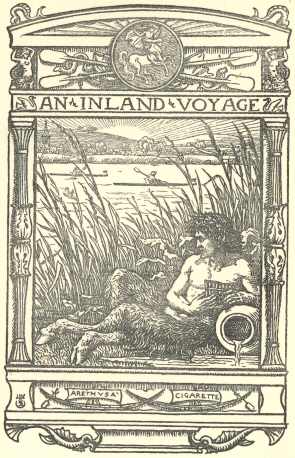
AN INLAND VOYAGE

CHATTO & WINDUS
1904PREFACE TO THE FIRST EDITION
CONTENTS
TO
SIR WALTER GRINDLAY SIMPSON, BART.p. 1ANTWERPTO BOOM
p. 8ON THEWILLEBROEK CANAL
p. 16THEROYAL SPORT NAUTIQUE
From Heaven,p. 25ATMAUBEUGE
p. 33ON THESAMBRE CANALISED: TO QUARTES
p.42PONT-SUR-SAMBRE
WE ARE PEDLARS
p. 51THETRAVELLING MERCHANT
p. 59ON THESAMBRE CANALISED: TO LANDRECIES
p. 67ATLANDRECIES
p. 75SAMBREAND OISE CANAL: CANAL BOATS
p. 83THEOISE IN FLOOD
p. 95ORIGNYSAINTE-BENOÎTE
A BY-DAY
p. 105THECOMPANY AT TABLE
p. 116DOWNTHE OISE: TO MOY
The ploughman from the sun his season takes.’p. 124LAFÈRE OF CURSED MEMORY
p. 133DOWNTHE OISE: THROUGH THE GOLDEN VALLEY
p.137NOYON CATHEDRAL
p. 145DOWNTHE OISE: TO COMPIÈGNE
p. 149ATCOMPIÈGNE
p.157CHANGED TIMES
p. 167DOWNTHE OISE: CHURCH INTERIORS
p.177PRÉCY AND THE MARIONNETTES
p. 194BACKTO THE WORLD
-
Previous
-
Next
- Recently published
-
- Seventeen, by Booth Tarkington
- The United States Bill of Rights
- Give Me Liberty Or Give Me Death
- John F. Kennedy's Inaugural Address
- The Soul of Nicholas Snyders, Or the Miser Of Zandam, by Jerome K. Jerome
- The Mayflower Compact
- Alice’s Adventures in Wonderland
- Lincoln’s First Inaugural Address
- The Soul of Nicholas Snyders, Or the Miser Of Zandam, by Jerome K. Jerome
- John F. Kennedy's Inaugural Address
- Random reads
-
- Findelkind, by Louise de La Ramee (aka Ouida)
- The United States Bill of Rights
- The Declaration of Independence of the United States of America
- The United States' Constitution
- The Dark Lady of the Sonnets, by Bernard Shaw
- The United States Bill of Rights
- Through the Looking
- Lincoln’s First Inaugural Address
- The Project Gutenberg eBook of Sir John Oldcastle, by
- The United States' Constitution
- Lincoln's Gettysburg Address
- John F. Kennedy's Inaugural Address
- The Project Gutenberg eBook of La Divina Commedia de Dante: Inferno, by Dante Alighieri
- The Mayflower Compact
- The United States' Constitution
- Lincoln’s First Inaugural Address
- Symposium, by Plato
- Lincoln's Gettysburg Address
- The United States Bill of Rights
- Through the Looking
- Search
-
- Friendly links
-
- gift interactive globes for 9 year olds
- realistic veterinarian playsets
- gift musical mats for 8 year olds
- music boxes for 11 year olds under 50 dollars
- musical plush toys for 2 year olds under 30 dollars
- fort building kits
- best microscope kits for 14 year olds under 25 dollars
- how to play with science kits for kids
- best durable miniature figures
- best stem toys for birthday
- Poems of Henry Timrod,
- The Project Gutenberg eBook of Master and Man, by Leo Tolstoy
- The Project Gutenberg eBook of Rose O’ The River, by Kate Douglas Wiggin.
- The Project Gutenberg eBook of La Divina Commedia di Dante: Inferno, by Dante Alighieri
- The Jew of Malta, by Christopher Marlowe
- The Project Gutenberg eBook of The Real Cyberpunk Fakebook, by St. Jude et al.
- The Divine Comedy, Complete
- Sketches of Young Couples, by Charles Dickens
- The Scarecrow of Oz
- A Woman of No Importance